
Beyond Coffee and Sugar: Brazil's Overlooked Natural Resources
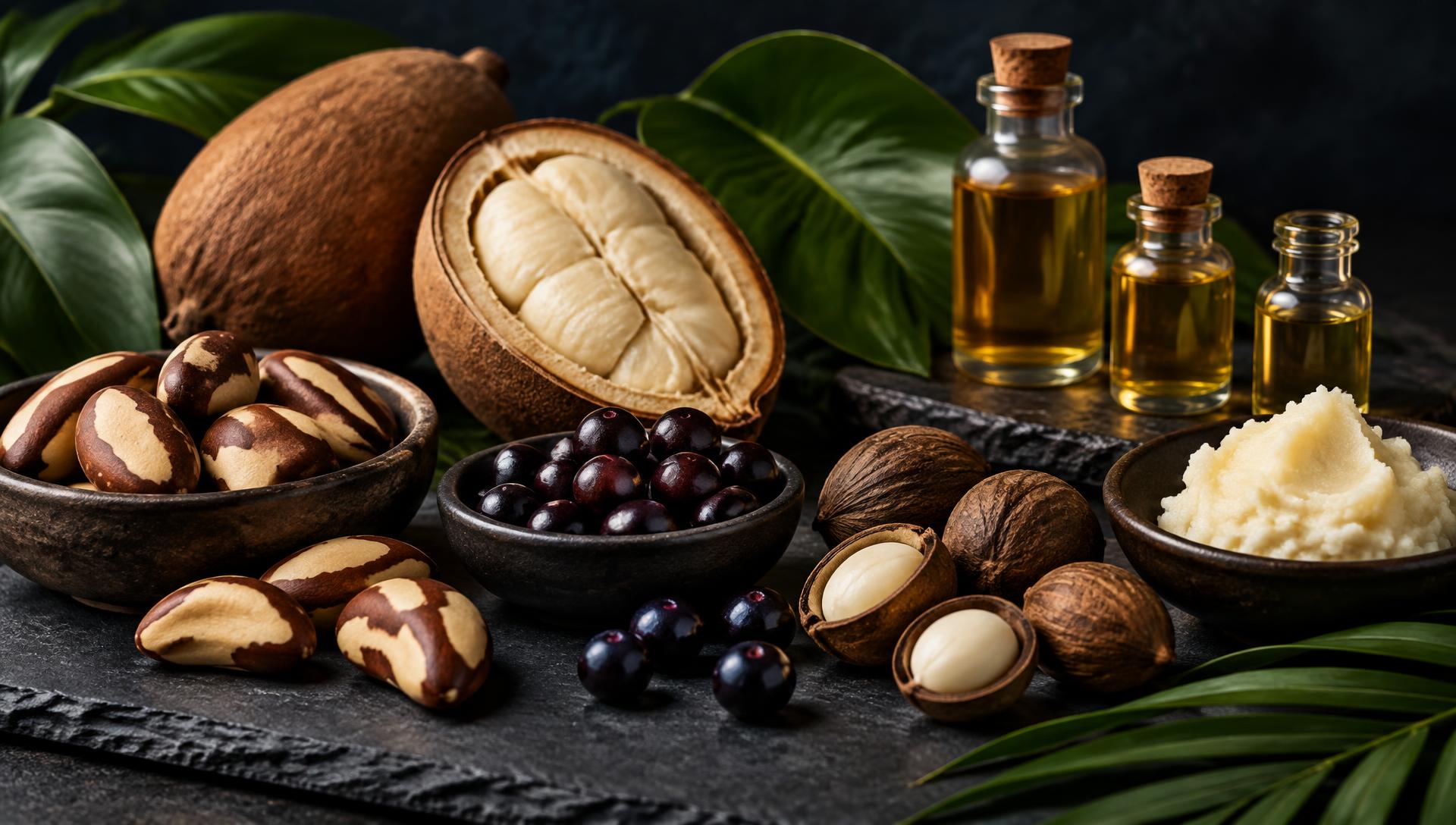
The Amazon's oils, butters and botanical ingredients point to a much larger opportunity hiding inside one of the world's most diverse natural-resource economies.
Ask an international buyer what Brazil exports and the answers are usually predictable.
Coffee. Sugar. Soybeans. Beef. Iron ore.
They are important industries, and Brazil's scale in many of them is extraordinary.
But they represent only part of the country's natural-resource story.
Across Brazil—and particularly across the Amazon—a very different group of products is beginning to attract attention from companies searching for natural ingredients, new formulations and more diversified sources of raw materials.
Oils extracted from seeds and fruits. Plant-based butters used in skin and hair products. Resins and botanical extracts. Ingredients derived from species that are familiar to communities in the Amazon but remain relatively unknown to consumers and product developers elsewhere.
Names such as andiroba, copaíba, murumuru, pracaxi, patauá, tucumã and ucuuba may not yet have the international recognition of coffee or açaí.
But that is precisely what makes them interesting.
The next chapter of Brazil's natural-resource economy may not simply be about producing more of the commodities the world already knows.
It may also be about discovering how to create responsible, scalable and commercially viable markets for resources the world has barely begun to associate with Brazil.
A Natural Laboratory of Extraordinary Scale
The Brazilian Amazon is frequently discussed in environmental terms—and appropriately so.
But it is also an enormous biological resource base.
Its forests contain fruits, seeds, nuts, palms, resins and botanical compounds that have been used locally for generations but have only gradually entered larger industrial supply chains.
Researchers studying Amazonian ingredients for cosmetics have documented species including açaí, andiroba, Brazil nut, buriti, cupuaçu, murumuru, patauá, pracaxi and ucuuba, among others. Their potential applications extend across skin care, hair care, fragrances and other personal-care formulations.
The commercial ecosystem is already developing.
Brazilian suppliers today offer ingredients such as murumuru butter, cupuaçu butter, ucuuba butter, tucumã butter, açaí oil, andiroba oil, Brazil-nut oil, copaíba oil-resin, pracaxi oil and breu-branco resin to international cosmetic and ingredient markets.
Yet outside specialist industries, many of these names remain largely unknown.
That gap between biological availability and international market awareness is where the opportunity begins.
From the Forest to the Formulation
The important question is not simply what grows in the Amazon.
It is what industry can do with it.
Consider murumuru.
Its seeds produce a butter already used in conditioners, shampoos, masks, creams and other cosmetic formulations. Commercial Brazilian suppliers offer it as an industrial ingredient rather than merely as a regional artisanal product.
Cupuaçu, a fruit closely associated with the Amazon, provides another example. Its pulp has food applications, while its seeds can be processed into a butter used by the cosmetics industry.
Andiroba produces an oil that has become an established ingredient in Brazilian personal-care formulations.
Copaíba produces an oil-resin with a long history of traditional use and a growing presence in cosmetic and specialty botanical markets.
Pracaxi, patauá, buriti, tucumã, Brazil nuts and ucuauba expand the list further.
This is an important distinction.
The Amazon should not be viewed merely as a source of unusual fruits.
It can also be viewed as a platform for ingredients.
And ingredients can enter many different products.
A single botanical resource might eventually find applications in shampoos, conditioners, moisturizers, soaps, serums, specialty foods or other formulations depending on its properties, processing and regulatory status.
That creates a much larger commercial landscape than selling the original fruit alone.
Açaí Offers a Useful Lesson
Few products demonstrate this progression better than açaí.
For generations, açaí was an everyday regional food in northern Brazil.
Internationally, it was virtually unknown.
Then the market changed.
Processing improved. Frozen pulp could travel. International distribution developed. Consumer awareness grew. Product formats multiplied.
A regional Amazonian fruit became a global ingredient.
Today, açaí appears in bowls, beverages, smoothies, powders, supplements and cosmetics around the world.
But there is another lesson in that story.
The opportunity was not created simply because açaí existed.
The fruit had always existed.
The commercial opportunity emerged when companies developed the processing, quality systems, cold chain, logistics, branding and distribution necessary to connect the resource to international demand.
Other Amazonian ingredients will face the same challenge.
Biodiversity provides the possibility.
Supply chains create the market.
Why Cosmetics May Be Particularly Interesting
Food is an obvious destination for Brazilian agricultural products, but cosmetics and personal care present a different kind of opportunity.
A formulation may require relatively small quantities of a specialty oil or butter compared with the enormous volumes required by mainstream food manufacturing.
That can make certain Amazonian ingredients commercially relevant even before their supply chains reach commodity scale.
The international cosmetics industry is also continuously searching for differentiated ingredients, particularly botanical materials with distinctive origin stories and functional properties.
This is already translating into organized commercial activity.
A partnership involving GIZ, fragrance and cosmetic-ingredient company Symrise, and Brazilian cosmetics company Natura works with cooperatives and associations on supply chains involving açaí, andiroba, babassu, cocoa, Brazil nuts, copaíba, cupuaçu, murumuru, patauá, tucumã, ucuuba and other ingredients.
According to the initiative, the areas influenced by participating cooperatives encompass more than 1.86 million hectares of forest managed through sustainable practices.
That demonstrates something important.
The Amazon bioeconomy is no longer simply an environmental concept.
Parts of it are becoming industrial supply chains.
The Opportunity Is Bigger Than Raw Materials
There is an even more interesting question.
Why stop at exporting the oil?
Brazil's long-term opportunity may be considerably larger if more value is created before the product leaves the country.
- Seeds can become oils.
- Oils can be refined or standardized.
- Fruit by-products can become specialty ingredients.
- Ingredients can become formulations.
- Formulations can eventually become finished products.
Every additional step potentially moves more economic value toward the region where the resource originates.
That is particularly significant for the Amazon.
The OECD's 2026 review of Brazil's production transformation found an important contradiction: Brazil is a global leader in scientific publications concerning the Amazon bioeconomy, yet accounts for only about 0.2% of global biotechnology patents. The OECD describes this as evidence of a weak translation of scientific knowledge into marketable products and argues for stronger links among research institutions, companies, cooperatives and traditional knowledge holders.
In other words, Brazil possesses enormous biological knowledge and resources.
The bigger challenge is converting more of that potential into scalable commercial innovation.
Palm Oil Shows Both the Opportunity and the Responsibility
The Amazon region is also home to a much larger established industry: palm oil.
Unlike many specialty Amazonian ingredients, palm oil already participates in enormous international markets spanning food, personal care, cosmetics and industrial applications.
Brazil's palm industry demonstrates what happens when a tropical resource moves into industrial-scale cultivation and processing.
But it also illustrates why growth must be approached carefully.
International buyers increasingly scrutinize palm supply chains for land use, environmental impact, labor conditions and traceability. Research into Brazilian palm production in Pará has likewise examined environmental, economic and social impacts throughout the production chain.
The lesson applies well beyond palm oil.
The commercial future of Amazonian ingredients cannot depend solely on the argument that they are natural.
Buyers increasingly need to know:
- Where did the ingredient come from?
- How was it harvested?
- Can its origin be traced?
- Is production environmentally responsible?
- Can quality remain consistent?
- Can supply grow without damaging the ecosystem that created the product?
Those questions will help determine which Amazonian ingredients remain niche curiosities and which become credible international industries.
Abundance Does Not Automatically Mean Export Readiness
This is perhaps the most important part of the story.
Brazil possesses extraordinary biodiversity.
That does not mean every interesting fruit, seed or botanical material represents a viable international business.
- Some products are available only seasonally.
- Some are harvested in very small quantities.
- Some lack standardized processing.
- Some may have inconsistent specifications.
- Some supply chains remain fragmented.
Others may face regulatory barriers depending on their intended application and destination market.
Scientific research has also identified quality-control and standardization as important issues surrounding Amazonian cosmetic ingredients.
So identifying an interesting Amazonian resource is only the beginning.
Before an international buyer can seriously consider it, basic commercial questions must be answered:
Volume. Specification. Processing. Quality. Certification. Traceability. Regulatory compliance. Packaging. Logistics. Price.
Without those pieces, biodiversity remains potential.
With them, it can become an industry.
Brazil's Opportunity Extends Beyond the Forest
The same broader principle applies elsewhere in Brazil.
The country possesses major mineral resources, specialty gemstones, industrial minerals and agricultural products that rarely receive the same international attention as iron ore, coffee, soybeans or sugar.
Brazil's enormous geographic scale and geological and biological diversity mean that its export economy has many possible layers.
Not every resource should be exploited simply because it exists.
And not every resource will make commercial sense.
But there is considerable room for businesses, researchers and entrepreneurs to look beyond the categories that have traditionally defined Brazil in global trade.
The opportunity is not simply to ask:
What does Brazil already export?
A more interesting question may be:
What does Brazil already possess that international markets have not yet fully discovered?
The Amazon's Most Valuable Export May Be Innovation
There is an understandable tension whenever economic development and the Amazon appear in the same conversation.
Protecting the forest matters.
So does creating economic opportunity for the people who live there.
Those goals do not necessarily have to compete.
A growing bioeconomy creates the possibility of assigning economic value to standing forests, renewable biological resources, local knowledge and responsible harvesting.
That model is already being tested commercially. Organizations working with Amazonian communities are building supply chains around forest ingredients while connecting conservation with income generation.
The challenge is scaling those models without destroying what makes them valuable.
And perhaps that is where Brazil's greatest opportunity lies.
Not simply exporting another raw commodity.
But transforming biodiversity into knowledge, ingredients, formulations, technology and products—while keeping more of the value creation close to where those resources originate.
Coffee, sugar, soybeans and iron ore will remain important parts of Brazil's economic story.
But they do not have to define its limits.
Somewhere among the fruits, seeds, palms, oils, butters and botanical compounds of the Amazon may be products that international consumers twenty years from now consider completely ordinary.
Today, many of them are still largely unknown.
And that is precisely what makes them worth exploring.
Key Takeaways
- Brazil's natural-resource economy extends far beyond its best-known agricultural commodities.
- The Amazon already supplies specialized oils, butters, resins and botanical ingredients to cosmetics, personal-care and other industries.
- Ingredients such as murumuru, cupuaçu, andiroba, copaíba, pracaxi and patauá illustrate the commercial potential of Amazonian biodiversity.
- The greatest opportunity may not be exporting more raw material, but developing higher-value ingredients and finished applications closer to origin.
- Biodiversity alone does not create a viable export business. Consistent volume, quality, processing, documentation, traceability and logistics are essential.
- Responsible commercialization can create an economic incentive to preserve the forest while generating income for communities connected to these supply chains.
Continue Reading
Brazil Beyond the Usual Commodities A broader look at the diversity of Brazil's agricultural economy and opportunities beyond its best-known exports.
Traceability Is Becoming the New Passport for Global Trade Why knowing where a product comes from is becoming increasingly important for international buyers.
Sustainability Is Becoming a Business Requirement, Not a Marketing Strategy How responsible sourcing, transparency and supply-chain resilience are becoming interconnected.
From Lowest Cost to Lowest Risk Why companies are expanding sourcing decisions beyond price alone.
References
OECD — Production Transformation Policy Review, 2026 Analysis of Brazil's productive capabilities, innovation ecosystem and the opportunity to convert Amazonian biodiversity research into higher-value commercial activity.
Bioeconomia Brasil — GIZ, Symrise and Natura Amazon Bioeconomy Partnership Information on Amazonian socio-biodiversity ingredient supply chains and participating cooperatives.
Beautycare Brazil — 100% Amazônia Export Showcase Current commercial examples of Amazonian oils, butters, resins and other cosmetic raw materials produced in Pará.
Química Nova — Amazon Rainforest Cosmetics: Chemical Approach for Quality Control Scientific review of Amazonian species used as cosmetic ingredients and challenges surrounding characterization and quality control.
Imazon — Amazon Bioeconomy Research Research examining the potential for Amazon biodiversity to provide inputs for cosmetics, food, biomedicine and other global markets.