
Brazil Beyond the Usual Commodities
Discovering the Export Opportunities the World Often Overlooks
When international buyers think about Brazilian agriculture, a familiar group of commodities usually comes to mind: soybeans, coffee, sugar, corn, beef and orange juice.
There is good reason for that.
Brazil is one of the world's great agricultural powers. In 2025, Brazilian agribusiness exports reached a record US$169.2 billion, representing 48.5% of the country's total exports.
But those headline numbers can obscure another side of Brazil's agricultural story.
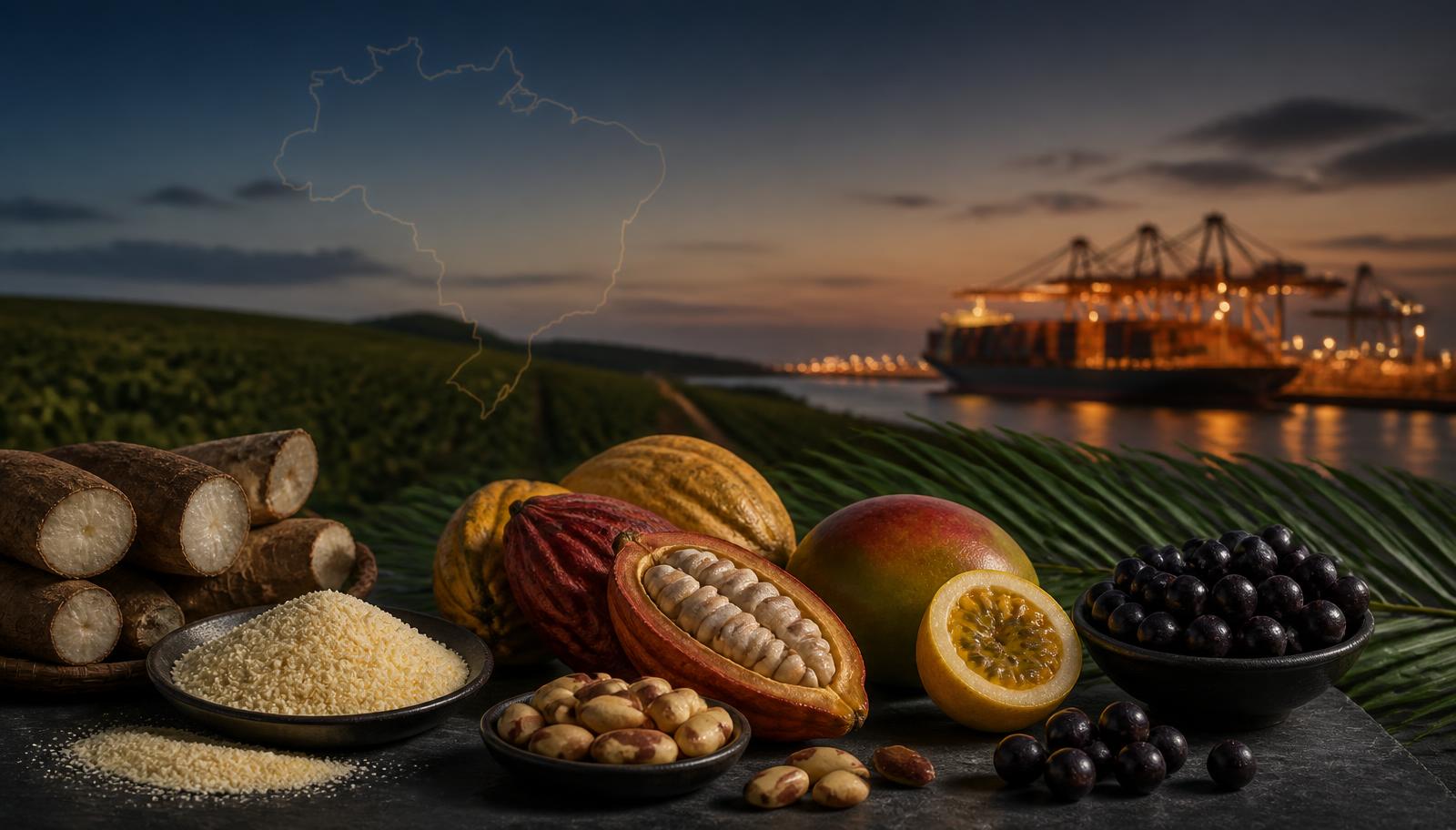
Beyond the commodities for which the country is already globally recognized lies an extraordinarily diverse production base—tropical fruits, cassava and its derivatives, cocoa, nuts, specialty ingredients, Amazonian products and countless regional foods that have long-established domestic markets but remain comparatively less visible internationally.
For global buyers, that gap between what Brazil produces and what the world commonly associates with Brazil may represent an opportunity worth exploring.
A Much Broader Agricultural Map
Brazil's continental size gives the country something relatively few agricultural origins possess: dramatically different climates, ecosystems and growing regions within the same national market.
The Amazon and northern Brazil produce açaí, cassava, Brazil nuts and numerous tropical fruits.
The Northeast has become an important center for mangoes, melons, grapes and other fruits, including significant production developed specifically for export.
Other regions support enormous production of coffee, cocoa, citrus, sugarcane, grains and a wide range of processed agricultural ingredients.
This diversity means that Brazil should not be viewed simply as a source of a handful of large commodities. It is better understood as multiple agricultural regions operating within one country, each with different products, capabilities and potential markets.
Fruit Offers a Glimpse of the Opportunity
Brazil's fruit industry illustrates how this broader export story is already beginning to develop.
In 2025, Brazil exported approximately 1.3 million metric tons of fruit, an increase of 19.7% from the previous year. Export revenue rose even faster—29%—to approximately US$1.56 billion.
Mangoes, melons, watermelons, lemons and limes represented more than 73% of the country's exported fruit volume.
The momentum has continued in 2026. In August alone, Brazilian exports of fresh or dried fruits and non-oil nuts reached approximately US$112 million, more than 50% above the value recorded in August 2025.
These numbers demonstrate both progress and possibility.
Brazil is already a significant fruit exporter, yet the country's biodiversity and production capabilities extend far beyond the relatively small number of fruits that currently dominate international shipments.
Cassava: Global Crop, Brazilian Roots
Cassava provides another interesting example.
The crop originated in South America and has been cultivated and processed in Brazil for centuries. Today it is deeply embedded in Brazilian cuisine and agriculture, appearing in products ranging from starch to tapioca and farinha de mandioca.
Brazil's 2025 cassava crop exceeded 20 million metric tons, demonstrating the scale of the country's production.
Yet much of Brazil's cassava economy remains domestically oriented.
This creates an interesting question for international trade: could some of the products that are commonplace in Brazil find larger markets abroad?
The answer will not necessarily be yes for every product. But as international consumers become more familiar with cassava-based foods, gluten-free ingredients, alternative starches and traditional regional products, Brazil has both the agricultural history and production base to participate in that conversation.
The Amazon Beyond Açaí
Perhaps nowhere is the gap between production potential and international awareness more apparent than in the Amazon.
Açaí has become a global success story. A fruit once consumed primarily in northern Brazil can now be found in supermarkets, smoothie shops and restaurants around the world.
But açaí is only one product from an ecosystem with extraordinary biodiversity.
The Amazon produces fruits, nuts, oils and other natural ingredients that remain largely unfamiliar to consumers outside Brazil.
That does not mean every Amazonian product will become the next açaí.
International markets require much more than an interesting product. Commercial success depends on consistent supply, food safety, processing capability, specifications, certifications, logistics, pricing and—most importantly—actual demand.
Nevertheless, açaí demonstrates something important: products that are deeply regional today can become international categories tomorrow when consumer demand, production capability and reliable supply chains come together.
Market Access Is Expanding
Brazil has also been actively working to broaden the international reach of its agricultural sector.
By the end of 2025, Brazil's Ministry of Agriculture reported more than 500 new market openings for agricultural products since 2023. The expansion has continued in 2026, with new access announced for products ranging from Brazilian fruits in Saudi Arabia to other agricultural goods across multiple destinations.
This matters because diversification does not happen simply by producing more.
Export markets require regulatory access, sanitary approvals, buyer confidence and supply chains capable of delivering products consistently across borders.
As those pathways expand, opportunities may emerge for products and producers that historically participated primarily in Brazil's domestic economy.
From Production to Export Opportunity
There is, however, an important distinction between a product that Brazil can produce and a product that Brazil can successfully export.
International buyers evaluate far more than availability.
They need the right specifications. They need consistency between shipments. They may require certifications, traceability, particular packaging formats or processing standards. Logistics must make economic sense. Pricing must remain competitive after freight, duties and distribution costs.
And ultimately, there must be a market.
This is where international trade becomes less about finding products and more about connecting capabilities.
A producer may have an excellent product without access to international buyers. A buyer may be searching for a new source without knowing which region or producer can reliably meet the required specifications.
Bridging that information gap is often where new trade relationships begin.
Looking Beyond the Familiar
Brazil's established commodities will remain fundamental to global agriculture. Soybeans, coffee, sugar, corn, beef and other major exports operate at a scale that few countries can match.
But the next chapter of Brazil's international agricultural growth may not come exclusively from making those already-large categories larger.
Part of it may come from introducing international markets to products they have not traditionally associated with Brazil.
Some will remain niche products. Others may find specialized foodservice, industrial or ethnic markets. And a small number may eventually develop into much larger international categories.
Identifying which is which requires patience, market intelligence and close cooperation between producers, buyers and those working across the supply chain.
The opportunity is not simply to export more.
It is to look more closely at what Brazil already produces—and ask where in the world it might create value.
Why This Matters
Brazil's agricultural export strength is well established, but international awareness remains concentrated around a relatively narrow group of major commodities. At the same time, fruit exports are growing, market access is expanding, and regional products such as cassava derivatives and Amazonian ingredients illustrate a much broader production base. For international buyers, the opportunity is not simply to discover something new—it is to identify products for which demand, specifications, compliance, logistics, pricing and reliable supply can be aligned.
Key Takeaways
- Brazilian agribusiness exports reached a record US$169.2 billion in 2025, equal to 48.5% of the country's total exports.
- Brazil's agricultural production base extends far beyond the commodities most commonly associated with the country.
- Brazil exported about 1.3 million metric tons of fruit worth US$1.56 billion in 2025, with export revenue up 29% year over year.
- In August 2026, exports of fresh or dried fruits and non-oil nuts reached about US$112.3 million, up 52.2% in value from August 2025.
- Brazil produced more than 20 million metric tons of cassava in 2025, yet much of the cassava economy remains domestically oriented.
- More than 500 agricultural market openings were secured from 2023 through the end of 2025, with additional openings continuing in 2026.
- Production capacity alone does not create an export opportunity; demand, specifications, compliance, logistics, pricing and consistency must align.
- Lesser-known Brazilian products may offer attractive niche or emerging opportunities, but each category must be evaluated on its own commercial fundamentals.
Continue Reading
Where Was It Really Made? Why Product Origin Matters More Than Ever
As governments increase scrutiny of transshipment and tariff circumvention, understanding where a product truly originates is becoming an essential part of international sourcing.
References
CONAB — Fruit and Vegetable Commercialization in Brazilian Ceasas Totals 16.6 Million Tons in 2025
IBGE — September 2025 Agricultural Production Estimate (cassava production)