The Certificate Arrived. What Does It Actually Prove?
What a Certificate of Analysis can—and can’t—tell an ingredient buyer.
The shipment is nearly ready. The supplier sends a Certificate of Analysis.
It carries a company name, a product description, a lot number and a table of results. At the bottom, a familiar word appears: “Pass.”
For a busy buyer, that can feel like the final reassurance needed to move forward.
But one question deserves attention before the document is filed away:
Pass against what—and for which product?
A Certificate of Analysis, commonly called a COA, can be a valuable part of an ingredient purchase. Its usefulness depends on how clearly it connects the product ordered, the material tested and the requirements agreed between buyer and seller.
Understanding that connection does not require becoming a laboratory scientist. It begins with knowing what to look for.
A Specification Sets the Expectation
Before interpreting a test result, a buyer needs something to compare it with.
That is the role of a product specification.
A specification describes the characteristics the product is expected to meet. Depending on the ingredient, these might include moisture, acidity, soluble solids, purity, microbiological criteria or other relevant attributes.
A Certificate of Analysis reports results or conformity statements for the material identified on the document.
The distinction matters.
A technical data sheet describing a product’s typical characteristics is not necessarily evidence of the results for the lot being shipped. Likewise, a sample certificate supplied during an initial discussion may help explain the supplier’s reporting format, but it does not establish the condition of a later production lot.
The specification tells the buyer what was agreed. The certificate helps show whether the identified material meets it.
“Pass” Can Still Leave a Question Open
Consider a hypothetical purchase of a powdered food ingredient.
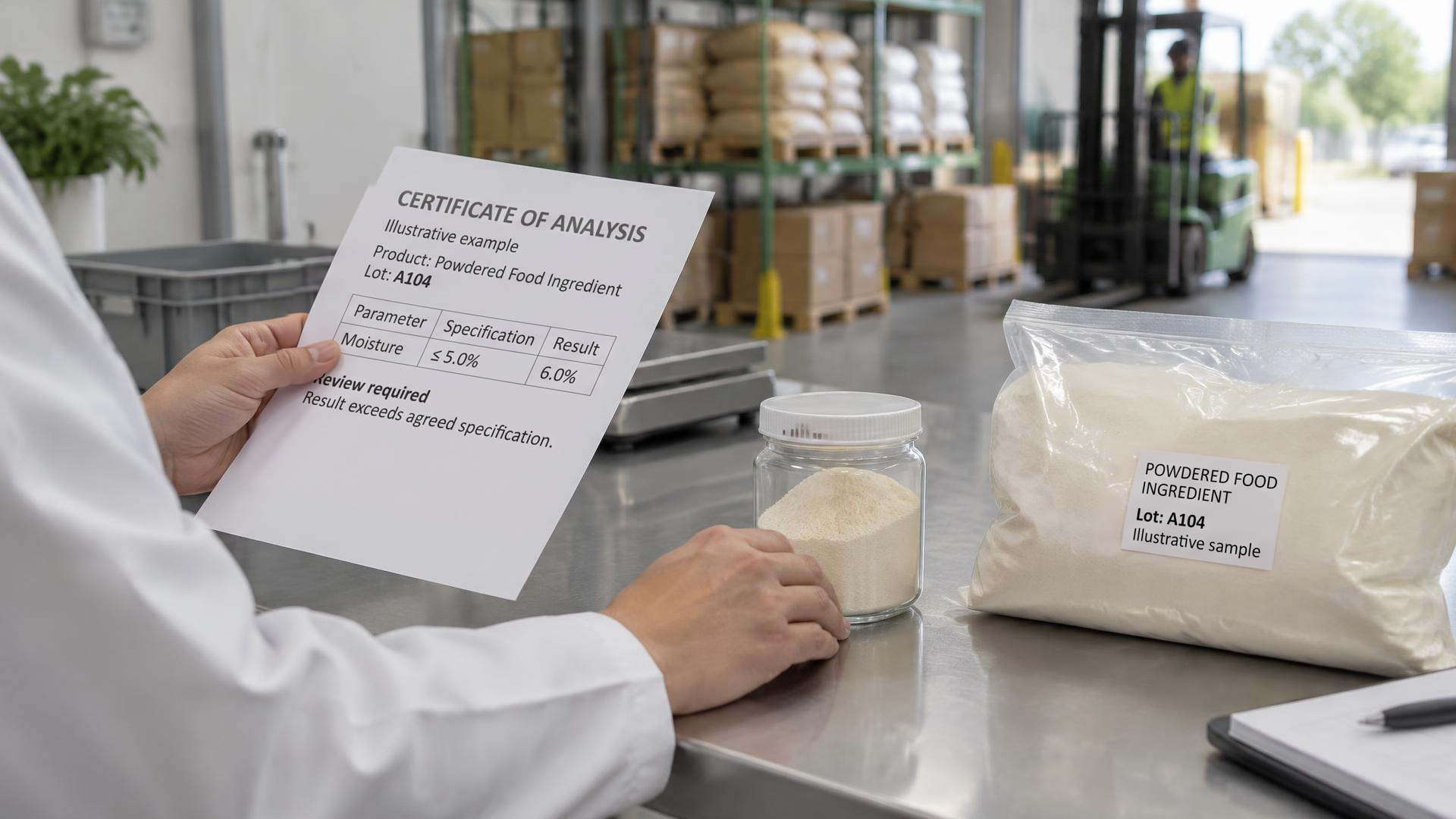
The buyer and supplier have agreed on a maximum moisture content of 5%. The certificate reports a result of 6% and labels it “Pass” because the supplier’s standard product limit is 7%.
The numbers here are illustrative, not recommended limits for any particular ingredient.
The laboratory result may be accurate. The supplier’s conclusion may also be consistent with its own standard.
But the material does not meet the requirement agreed for that order.
The problem becomes visible only when someone compares the certificate with the purchasing specification.
This is why “Pass” should begin a review rather than end it. A result needs to be read alongside the applicable limit, unit of measurement and, where relevant, test method.
For procurement teams, that review is easier when the commercial and technical requirements have been aligned before production begins.
First, Match the Paper to the Shipment
A certificate can contain reassuring results and still be the wrong document for the goods arriving.
Imagine receiving a certificate for lot A104 while the packages in the shipment are marked A140. It could be a simple administrative error. But until the difference is resolved, the connection between the test results and the delivered material remains unclear.
A useful first review therefore starts with identification:
- Does the product name and grade match the order?
- Does the lot or batch identification match the goods?
- If the shipment contains several lots, does the documentation cover each one?
- Are the sampling, testing and production dates, where provided, consistent with the material being supplied?
- Is it clear who issued the certificate and who performed the testing?
A certificate issued by a manufacturer does not automatically mean an independent laboratory tested the product. An outside laboratory’s report also needs to be connected to the correct sample and lot.
The question is whether the document provides a clear, credible link to the shipment.
A Laboratory Tests a Sample
One of the most important facts about testing is also one of the easiest to overlook:
The laboratory usually examines a sample, not every package in the shipment.
How that sample was collected affects what the result can tell us about the wider lot.
If a problem is unevenly distributed, a sample may miss it. A result from one part of a lot cannot automatically establish the condition of every other part.
The Canadian Food Inspection Agency emphasizes the importance of collecting samples representative of the lot being assessed. FDA guidance similarly explains that hazards may not be distributed evenly and that the analytical method’s sensitivity affects what testing can detect. CFIA sampling procedures, FDA supplier-verification guidance
This gives buyers a reason to ask how sampling was performed, particularly when a result supports an important safety or quality decision.
It also explains why a certificate should be considered alongside the supplier’s controls and production practices. Testing contributes evidence; the process behind the product helps explain how consistently the supplier can meet requirements.
Read the Words Around the Number
Some of the most meaningful information on a certificate appears in small details.
“Not detected,” for example, should be interpreted in relation to the method used and the quantity tested. It does not establish absolute absence throughout an entire shipment.
A missing result also deserves care. A blank space could mean a test was not performed, was not applicable or was omitted from that report. The buyer should clarify which explanation applies.
Units matter as well. Two results cannot be compared reliably without understanding whether they use the same units and reporting basis.
The practical response is to resolve these questions with the supplier or laboratory. For specialized parameters, the buyer’s quality or technical team should help interpret the result.
The objective is straightforward: everyone should understand the evidence in the same way before making a decision.
A Certificate Cannot Describe the Whole Journey
Even a well-prepared certificate has a scope.
It may report moisture, acidity and selected microbiological results. Those entries do not automatically establish that every other relevant characteristic was examined.
Nor does a production-stage certificate, by itself, document everything that happened during transportation.
A frozen ingredient could leave the processing facility with satisfactory results and later experience a temperature problem. Packaging could be damaged in transit. The goods delivered could differ from the lot named in the documents.
That is why receiving checks, packaging inspection, traceability and appropriate transport records still matter.
The same principle applies to regulatory responsibilities. FDA’s Foreign Supplier Verification Programs framework uses risk-based supplier verification, with activities that can include audits, sampling and testing, and review of relevant records. The appropriate approach depends on the food, its hazards and the supplier’s performance. A certificate alone does not automatically satisfy every applicable obligation. FDA FSVP key requirements
Make the Document Useful Before It Arrives
The best time to discuss a certificate is before the shipment is ready.
Buyer and supplier can agree on the specification, the results to be reported, the lot identification required and when the document must be available for review.
They can also establish how to handle a missing test, an unexpected result or a mismatch between the certificate and the order.
That preparation turns the COA into a working part of the transaction. Purchasing knows what was agreed. The supplier knows what evidence is expected. The receiving team knows which documents belong with the goods.
When the certificate arrives, the buyer can answer a more useful question than “Do we have one?”
“Does this document support accepting this particular shipment against the requirements we agreed?”
Editor’s Perspective
International sourcing depends on documents, but their value comes from the connection between the paperwork and the physical product.
A Certificate of Analysis is most useful when someone reads it against the order, checks its identity and understands its scope.
Often, the most valuable question is a simple one: “Can you show me how this result relates to the goods we are receiving?”
That conversation is much easier to have before the shipment moves.
Key Takeaways
- A specification defines the agreed requirements; a COA reports results or conformity for the material identified.
- “Pass” should be checked against the buyer’s agreed specification.
- Product and lot identification must connect the certificate to the shipment.
- Sampling and test methods influence what results can establish.
- A COA supports a broader quality and verification process that includes the supplier, transportation and receiving checks.
Continue Reading
- Brazilian Tropical Fruit Pulps: A Buyer’s Guide to Products, Processing and International Trade
- Traceability Is Becoming the New Passport for Global Trade
Sources & Further Reading
- Canadian Food Inspection Agency — Sampling procedures
https://inspection.canada.ca/en/preventive-controls/sampling-procedures?wbdisable=true
- FDA — Guidance for Industry: Foreign Supplier Verification Programs for Importers of Food for Humans and Animals
https://www.fda.gov/media/118241/download
- FDA — FSVP Key Requirements