
Brazilian Tropical Fruit Pulps: A Buyer’s Guide to Products, Processing and International Trade
From açaí and acerola to passion fruit, guava and cupuaçu, Brazil’s tropical fruit sector offers far more than familiar flavors. Understanding the products, processing methods, specifications and trade requirements behind these ingredients is essential for companies working with them internationally.
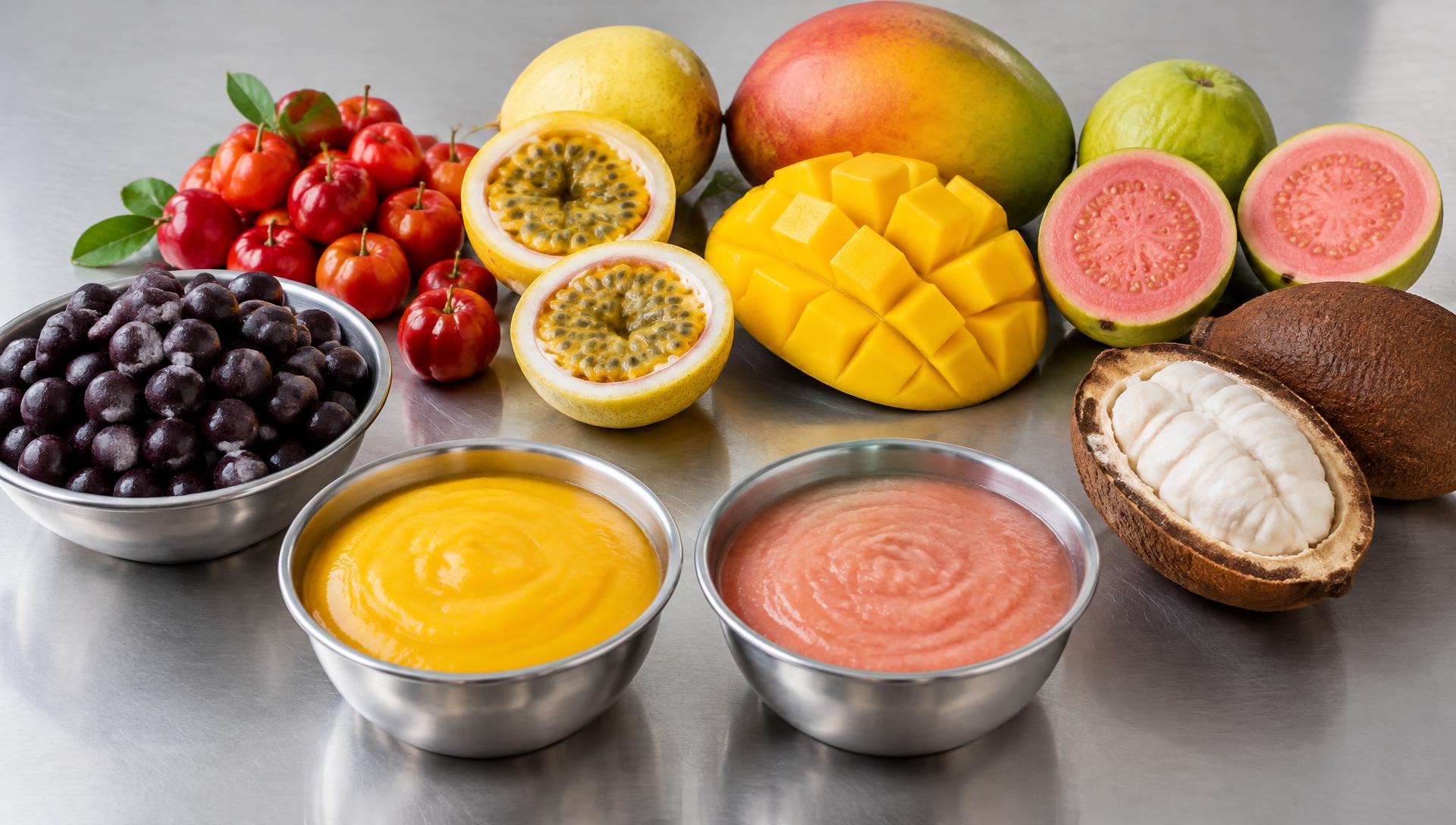
Brazil is one of the world's most geographically and agriculturally diverse countries. Across the Amazon, Northeast, Southeast and other producing regions, climate and growing conditions support a remarkable variety of tropical fruits — many of which have developed important markets far beyond the regions where they originated.
But moving tropical fruit into international commerce presents a fundamental challenge.
Many tropical fruits are highly perishable. Production may also be seasonal and concentrated hundreds or thousands of miles from the eventual consumer.
Fruit pulp processing helps bridge that gap.
By separating the usable portion of the fruit and processing it into a format suitable for preservation, storage and transportation — commonly frozen — producers can extend the commercial reach of fruits that would otherwise be difficult to move through international supply chains.
For international buyers, however, the term “fruit pulp” describes a category that is considerably more complex than it first appears.
Understanding that complexity begins at the source.
Brazil Is Not One Tropical Fruit Market
Brazil's tropical fruit industry is better understood as a collection of regional agricultural supply chains rather than a single national production zone.
According to 2025 data from the Brazilian Institute of Geography and Statistics (IBGE), Brazil produced more than 2 million metric tons of cultivated açaí, with Pará overwhelmingly leading production.
Brazil also produced approximately 865,000 metric tons of passion fruit, with Bahia as the country's largest producer. Pineapple production reached approximately 1.6 billion fruits, led by Paraíba.
Other fruits have their own geographic centers of production.
This regional specialization matters because the origin of a fruit can influence seasonality, transportation to the processing facility, available varieties, processing infrastructure and ultimately the structure of the supply chain.
It also highlights something easily overlooked by international buyers:
Buying tropical fruit pulp from Brazil does not mean accessing one supply chain. Different fruits can lead to entirely different regions, processors and commercial dynamics.
What Exactly Is Fruit Pulp?
Commercial terminology can become confusing quickly.
Fruit pulp, fruit purée, juice, concentrate and nectar are sometimes used casually as though they describe the same product. They do not necessarily represent the same composition or processing method.
Brazil itself maintains formal identity and quality standards for numerous fruit pulps through the Ministry of Agriculture and Livestock (MAPA).
These standards cover fruits ranging from widely recognized products such as mango, guava, passion fruit and pineapple to distinctly Brazilian fruits including açaí, acerola, cajá, cupuaçu, graviola, pitanga, umbu, bacuri and buriti.
That regulatory framework recognizes an important reality:
Fruit pulp is not a uniform commodity.
The natural characteristics of each fruit vary significantly. Soluble solids, acidity, pH, color, fiber, flavor intensity and other attributes can differ from one species to another.
For an international buyer, therefore, purchasing “Brazilian fruit pulp” is not enough of a specification.
The actual fruit, composition and processing method matter.
Six Fruits That Illustrate Brazil's Diversity
A few examples demonstrate just how broad the category can be.
Açaí
Native to the Amazon region and strongly associated with Pará, açaí has evolved from a regional staple into an internationally recognized ingredient. Outside Brazil, it is widely associated with bowls, smoothies, beverages and frozen products.
Acerola
A small tropical fruit notable for its naturally high vitamin C content. Beyond juices and frozen products, acerola has attracted interest as an ingredient in applications where its nutritional characteristics are relevant.
Passion Fruit
Known in Brazil as maracujá, passion fruit has an intense aroma, pronounced acidity and distinctive flavor. Its pulp is used across beverages, desserts, dairy applications, sauces and other food products.
Mango
Already familiar to consumers worldwide, mango demonstrates another side of Brazil's fruit-processing industry: converting a globally recognized fruit into an ingredient that can be used consistently in beverages, desserts and food manufacturing.
Guava
Guava offers a distinctive aroma, color and flavor profile and has long-standing applications in beverages, desserts, confectionery and other processed foods.
Cupuaçu
A fruit native to the Amazon and related botanically to cacao, cupuaçu remains less familiar internationally. Its distinctive flavor and aroma make it particularly interesting as global food companies and consumers explore ingredients beyond established tropical categories.
Together, these fruits demonstrate why Brazil's tropical pulp sector should not be viewed as a single product market. It spans familiar global commodities, regionally important fruits and ingredients that are still relatively unknown outside Brazil.
Why Frozen Pulp Matters
Processing fruit into pulp addresses one of the fundamental problems of tropical agriculture: time.
Fresh fruit begins changing from the moment it is harvested. Depending on the fruit, distance from the growing region, infrastructure and intended market, moving fresh product internationally may be commercially difficult or impractical.
Processing closer to origin allows the usable portion of the fruit to enter a different type of supply chain.
Freezing is particularly important because it can preserve the product while extending the time available for storage, transportation and commercial use.
But freezing does not eliminate supply-chain requirements.
It creates new ones.
Once a product enters a frozen supply chain, temperature management becomes part of product integrity. Storage at the processor, inland transportation, port handling, international freight, customs clearance, warehousing and final distribution all become links in the same cold chain.
A failure at one stage can affect a product that was produced correctly at the factory.
For buyers, this means evaluating frozen fruit pulp requires understanding not only the ingredient but also how the ingredient will travel.
What Should a Buyer Actually Specify?
One of the most common mistakes in ingredient sourcing is discussing price before defining exactly what is being purchased.
For tropical fruit pulp, buyers may need to evaluate questions such as:
- Is the product 100% fruit pulp, or are other ingredients present?
- Is sugar added?
- Has the product been pasteurized or otherwise processed?
- What are the applicable soluble-solids, pH or acidity specifications?
- What microbiological parameters apply?
- How is the product packaged?
- What is the unit size and case configuration?
- What storage conditions are required?
- What is the stated shelf life?
- How are production lots identified and traced?
- What documentation accompanies the product?
Not every parameter applies in the same way to every fruit or application.
A pulp intended for an industrial beverage manufacturer may have different commercial requirements from one intended for a smoothie operation, frozen dessert producer or foodservice distributor.
This is why a technically clear specification often becomes more valuable than a simple product description.
“Frozen mango pulp” identifies a category. It does not necessarily identify the product a buyer needs.
Pulp, Purée, Juice or Frozen Fruit? Classification Matters
Terminology matters for another reason: international trade classification.
Products that appear similar commercially can be treated differently depending on composition, processing and presentation.
A 2025 Brazilian tariff-classification decision involving frozen, unpasteurized acerola and guava pulp illustrates the issue. The products were manufactured through washing, pulping, refining and standardization without other substances being added and were intended primarily for uses including juices, beverages and ice cream.
The classification analysis placed those products under Brazil's NCM tariff system for frozen fruit.
The broader lesson is more important than the individual classification:
A commercial product name does not by itself determine customs treatment.
Whether a product is pulp, purée, juice, concentrate or another preparation can have implications for tariff classification, documentation and import requirements.
International buyers should therefore understand both what a supplier calls the product and how the product is defined for customs and regulatory purposes in the destination market.
Crossing the Border Changes the Rules
Export compliance does not end when a product satisfies the requirements of the country where it was produced.
The destination country has its own rules.
Brazil's Ministry of Agriculture maintains requirements governing fruit-pulp establishments and products and, in 2026, published an updated guide addressing the regularization and export of fruit pulps.
For companies importing food into the United States, another regulatory framework enters the transaction.
Under the U.S. Food and Drug Administration's Foreign Supplier Verification Programs, or FSVP, importers covered by the rule generally have responsibilities for verifying that foreign suppliers produce food in accordance with applicable U.S. food-safety requirements.
Those responsibilities can include hazard analysis, evaluation of the food and supplier, appropriate supplier-verification activities, corrective actions and recordkeeping.
FDA also requires imported human foods to meet applicable U.S. requirements involving areas such as facility registration, prior notice and labeling.
This leads to an important principle for international food trade:
Food compliance does not stop at the exporting country's border.
The producer's responsibilities in Brazil and the importer's responsibilities in the United States are different parts of the same commercial transaction.
Traceability Becomes Part of the Product
Fruit pulp also demonstrates why traceability has become increasingly important in international food supply chains.
A finished package may contain fruit harvested in a particular region, processed on a particular date, packed under a specific production lot and transported through several logistics providers before reaching the customer.
When everything works properly, much of that information remains invisible.
When something goes wrong, it becomes essential.
Lot identification, production records, raw-material information, processing records and logistics documentation can help determine where a problem originated and which products may be affected.
Traceability therefore serves more than regulatory compliance.
It supports quality control, inventory management, recall capability and commercial accountability.
For international buyers, the ability to trace a product backward through the supply chain can be almost as important as moving it forward.
A Market Best Understood Through the Product
Brazil's tropical fruit diversity creates significant possibilities for international food companies.
But understanding those possibilities requires looking beyond the fruit itself.
Agricultural origin influences supply. Processing determines product characteristics. Specifications define what the buyer is actually purchasing. Packaging and cold-chain management influence how the product arrives. Customs classification affects how it crosses borders. Food-safety regulations determine responsibilities on both sides of the transaction.
The result is a category where agriculture, food manufacturing, logistics and international trade intersect.
And perhaps that is the most useful way to understand Brazilian tropical fruit pulp.
Not simply as frozen fruit.
But as an agricultural ingredient whose commercial value depends on preserving its identity and integrity from the place where the fruit is grown to the market where it will ultimately be used.
Editor's Perspective
Tropical fruit pulp illustrates an important principle of international food trade: the product is only one part of what the buyer is purchasing.
Specification, processing method, regulatory classification, packaging, cold-chain integrity, traceability and destination-market compliance all influence whether an ingredient ultimately performs as expected.
Understanding those details before discussing price often leads to better commercial decisions than beginning with price alone.
Key Takeaways
- Brazil's tropical fruit sector is made up of distinct regional supply chains. Different fruits are concentrated in different producing regions, creating different sourcing and logistics dynamics.
- Fruit pulp is not a uniform commodity. Composition, processing method and technical specifications vary significantly between fruits and products.
- Frozen pulp helps connect highly perishable tropical agriculture with international markets, but it also creates cold-chain requirements throughout transportation and distribution.
- Product specifications should come before price comparisons. Composition, processing, packaging, shelf life, microbiological requirements and traceability can materially affect whether two quotations actually represent comparable products.
- Commercial terminology and customs classification are not necessarily the same thing. Composition and processing can influence how a product is classified for international trade.
- Import compliance involves both sides of the transaction. Meeting Brazilian requirements does not replace the obligations that may apply to an importer in the destination market.
- Traceability is increasingly part of product integrity. Knowing where a product came from, how it was processed and which lot it belongs to supports quality, compliance and accountability.
Sources & Further Reading
Brazilian Institute of Geography and Statistics (IBGE) — Agricultural production data, including 2025 açaí, passion fruit and pineapple production.
https://www.ibge.gov.br/explica/producao-agropecuaria/acai-cultivo/br
https://www.ibge.gov.br/explica/producao-agropecuaria/maracuja/br
https://www.ibge.gov.br/explica/producao-agropecuaria/abacaxi/br
Brazilian Ministry of Agriculture and Livestock (MAPA) — Identity and quality standards for fruit pulp and related beverages.
Brazilian Ministry of Agriculture and Livestock (MAPA) — Guide to Regularization and Export of Fruit Pulp, updated March 2026.
U.S. Food and Drug Administration (FDA) — Foreign Supplier Verification Programs (FSVP) for Importers of Food for Humans and Animals.
U.S. Food and Drug Administration (FDA) — Guidance on importing human foods into the United States.
https://www.fda.gov/industry/importing-fda-regulated-products/importing-human-foods
Brazilian Federal Revenue / Mercosur tariff-classification resources — Classification guidance and decisions concerning processed and frozen fruit products.