Brazil and the Global Sugar Supply
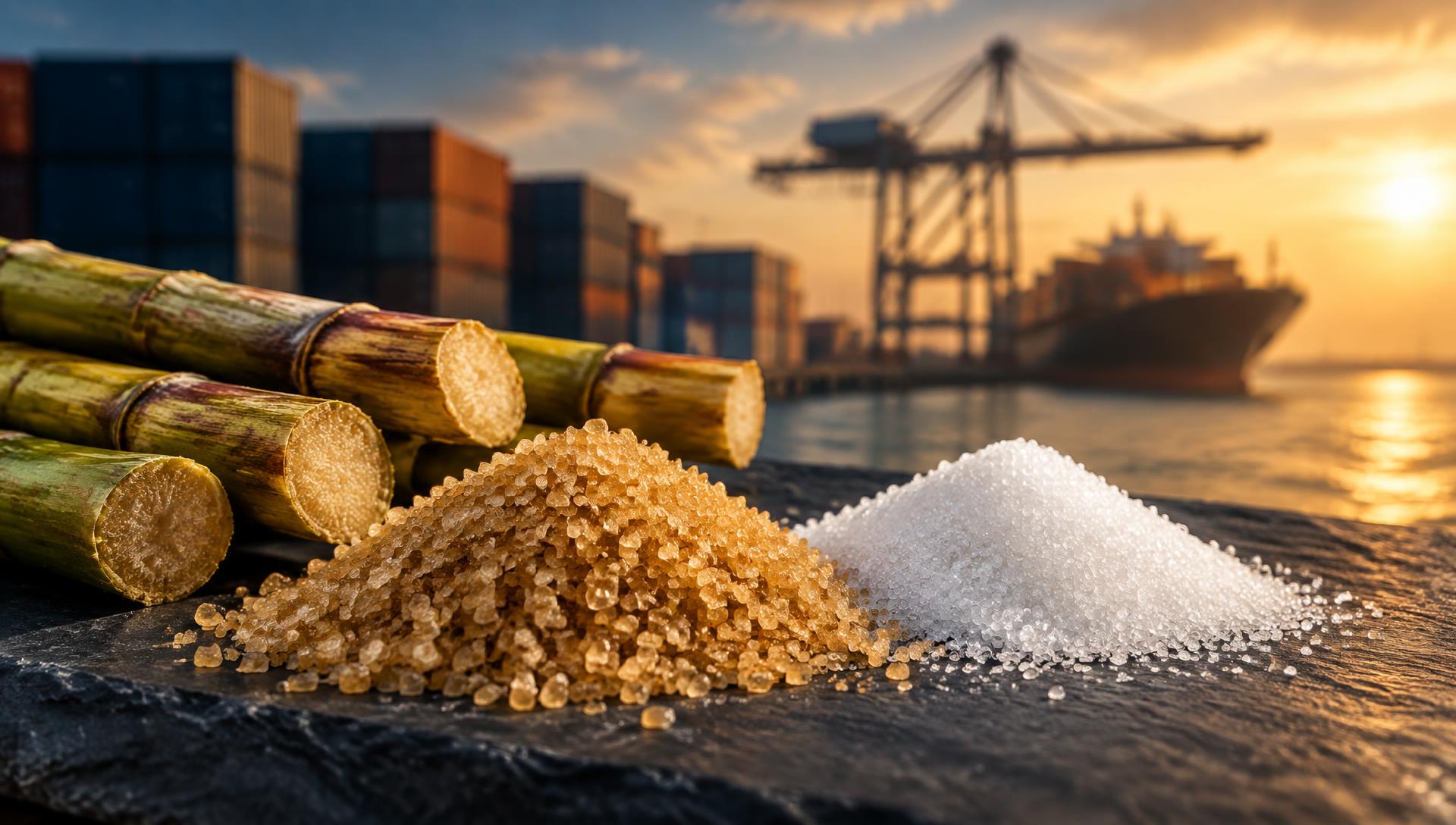
From sugarcane fields to international buyers, understanding the supply chain behind one of Brazil's most important exports.
Sugar is one of the world's oldest traded commodities. Yet behind something that appears relatively simple—a standardized product bought and sold by the ton—is a surprisingly complex international supply chain.
Few countries influence that supply chain as much as Brazil.
For the 2025/26 marketing year, the U.S. Department of Agriculture estimates Brazilian sugar production at approximately 43.8 million metric tons, representing roughly 23.5% of global production. Brazil is currently the world's largest sugar producer, ahead of India, the European Union, China and Thailand.
But Brazil's importance to international sugar buyers is about more than scale.
From decisions made at the sugar mill to product specifications, packaging, port infrastructure, freight and documentation, getting Brazilian sugar from the field to an international customer involves a chain of decisions that can significantly affect the final economics of a transaction.
Understanding that chain is increasingly important for companies looking to source sugar internationally.
A Global Industry That Begins in the Field
Brazil's sugar industry begins with sugarcane, but the crop does not have only one destination.
Sugarcane can be processed into sugar or ethanol, giving Brazilian mills a degree of flexibility that distinguishes the country's industry from many other sugar-producing regions.
The allocation between the two can change according to market conditions, crop characteristics and operational considerations.
That flexibility matters internationally because decisions being made at Brazilian mills can ultimately influence how much sugar reaches the export market.
The 2026 harvest provides a particularly interesting example. Wet conditions in Brazil's Center-South have affected sugar concentration in the cane and complicated harvesting, with mills maintaining a more ethanol-oriented production mix despite stronger sugar prices. The situation illustrates something international buyers sometimes overlook: commodity prices alone do not determine available supply. Agricultural conditions and processing economics matter as well.
Sugar Is Not Simply Sugar
For someone outside the industry, purchasing sugar may sound straightforward.
Determine the quantity. Obtain a price per metric ton. Arrange transportation.
In practice, the first question should often be much more basic:
What sugar does the buyer actually need?
International sugar trade includes different grades and specifications depending on the intended market and application. Color, polarization, moisture, ash content, grain characteristics and other quality parameters can all matter.
One commonly encountered measurement is ICUMSA, a standardized method widely used in the sugar industry to describe characteristics including sugar color.
The appropriate specification depends on what happens after the sugar arrives.
A food manufacturer using sugar as an ingredient may have requirements different from those of a distributor supplying retail or foodservice customers. A refinery purchasing raw sugar operates under a different commercial model again.
Before discussing price, therefore, buyer and supplier need to agree on the product.
Otherwise, two quotations that appear to describe the same commodity may not actually be comparable.
Packaging Changes the Supply Chain
The next decision is how the sugar will travel.
Large industrial transactions can involve bulk shipments, while other buyers require bagged sugar or containerized cargo.
Bag size, palletization, container configuration and handling requirements can affect warehousing, transportation and ultimately landed cost.
Brazil's export infrastructure accommodates these different models.
The Port of Paranaguá, for example, handled approximately 6.4 million metric tons of sugar in 2024, according to Portos do Paraná. The port maintains dedicated infrastructure for bulk sugar and has continued expanding its role in agricultural exports.
In the first two months of 2026, Paranaguá accounted for approximately 11% of Brazil's sugar export movement, with particularly strong growth in bagged sugar shipments.
Santos is another critical gateway. During the first half of 2025 alone, approximately 8.83 million metric tons of sugar moved through the Port of Santos.
Infrastructure on this scale is one of the reasons Brazil can serve buyers ranging from major industrial commodity purchasers to companies requiring more specialized export programs.
The Price per Ton Is Only the Starting Point
International buyers naturally focus on price.
But the number quoted at origin does not necessarily represent what the product ultimately costs when it reaches the buyer.
The commercial terms of the transaction matter.
A quotation may be structured around different Incoterms and different points in the supply chain. Depending on the agreement, responsibility for inland transportation, port handling, ocean freight, insurance and other costs may shift between seller and buyer.
Then come destination costs.
Import duties or quotas, customs clearance, port charges, inspections, warehousing and domestic transportation can significantly alter the economics of a shipment.
For that reason, comparing sugar offers solely on the basis of a price per metric ton can be misleading.
A more useful comparison is often:
What will this product cost when it reaches the place where the buyer actually needs it?
That is the difference between an attractive quotation and an attractive landed cost.
Logistics Can Be as Important as Production
Brazil can produce enormous quantities of sugar.
But production capacity alone does not put the product in a customer's warehouse.
Sugar must move from mills through Brazil's inland transportation network to warehouses, terminals and ports before beginning the international portion of its journey.
Port capacity, vessel schedules, container availability, trucking, storage and seasonal congestion can all influence shipment timing and cost.
This is particularly important in an agricultural export economy where sugar may be moving through the same logistics network as soybeans, corn, coffee and other major commodities.
For buyers, this means supplier evaluation should extend beyond the factory.
A competitive mill without a reliable logistics solution can still become an unreliable supply chain.
Traceability Is Entering the Sugar Conversation
Another change is taking place further upstream.
International buyers are increasingly asking where agricultural commodities originate and how they were produced.
Sugar is no exception.
Bonsucro, the international sustainability organization focused on sugarcane, launched a two-year initiative in 2026 called Empower & Exchange. The project is intended to improve how verified environmental, social and governance information is organized and exchanged among mills, producers, buyers and other participants in the sugarcane supply chain.
The development reflects a broader shift across international sourcing.
Quality and price remain fundamental. But for some buyers, supplier qualification increasingly includes questions about certification, traceability, environmental practices and the ability to document origin.
The sugar itself may look identical.
The information traveling with it may not be.
The Supplier Is Only One Part of the Decision
Finding a company capable of producing sugar is relatively easy in a country with an industry the size of Brazil's.
Determining whether that supplier is appropriate for a particular buyer requires considerably more work.
A sourcing decision may involve evaluating:
Product specification. Production capacity. Packaging. Certifications. Documentation. Payment terms. Export experience. Logistics capability. Port access. Shipment schedule.
And increasingly:
Traceability.
None of these factors independently guarantees a successful transaction.
Together, however, they determine whether a supplier can consistently deliver the product the buyer expects, under commercially workable conditions.
From Brazil to the Buyer's Door
Perhaps the most useful way to think about international sugar sourcing is not as a commodity purchase but as a sequence.
Sugarcane → Mill → Specification → Packaging → Inland Logistics → Port → Ocean Freight → Import Clearance → Domestic Delivery → Buyer
Every step adds either cost, time, risk—or value.
The strongest sourcing programs therefore work backward from the buyer rather than forward from the mill.
What product is required?
Where must it be delivered?
How frequently?
In what packaging?
Under what specification?
What certifications or documentation are required?
What volume makes the logistics economically viable?
Only after those questions are understood does it become possible to determine which Brazilian supplier and commercial structure make the most sense.
Brazil's Scale Creates Opportunity. Execution Creates the Supply Chain.
Brazil's position in global sugar is difficult to overstate.
A country responsible for nearly one-quarter of global production inevitably influences availability, trade flows and international pricing.
But for an individual buyer, Brazil's scale is not necessarily the most important consideration.
The real question is whether that enormous production base can be translated into the right sugar, from the right supplier, under the right commercial terms, delivered to the right destination at a competitive landed cost.
That is where international sourcing becomes more than a commodity transaction.
It becomes supply-chain design.
Key Takeaways
- Brazil is currently the world's largest sugar producer, accounting for roughly 23.5% of estimated global production in 2025/26.
- Brazilian mills can allocate sugarcane between sugar and ethanol, meaning weather, crop characteristics and processing economics can influence exportable sugar supply.
- Sugar specifications matter. Buyers should define the required product before comparing supplier quotations.
- Packaging, palletization, shipment method and port selection can materially affect logistics and landed cost.
- A low price per metric ton does not necessarily mean a low delivered cost.
- Supplier qualification should consider production capability, specifications, documentation, certifications, logistics and export experience—not price alone.
- Traceability and sustainability information are becoming increasingly relevant considerations for some international sugar buyers.
- Effective international sourcing starts with the buyer's requirements and works backward through the supply chain.
Continue Reading
From Lowest Cost to Lowest Risk — why international sourcing decisions increasingly extend beyond the initial purchase price.
Traceability Is Becoming the New Passport for Global Trade — how documentation and visibility into origin are becoming increasingly important in global supply chains.
Successful Import Starts Long Before the Shipment Leaves the Port — the importance of planning specifications, documentation and logistics before cargo moves.
The New Cost of Uncertainty — how changing trade conditions can influence sourcing and supply-chain decisions.