
The New Cost of Uncertainty: Why Importers Are Rethinking Inventory
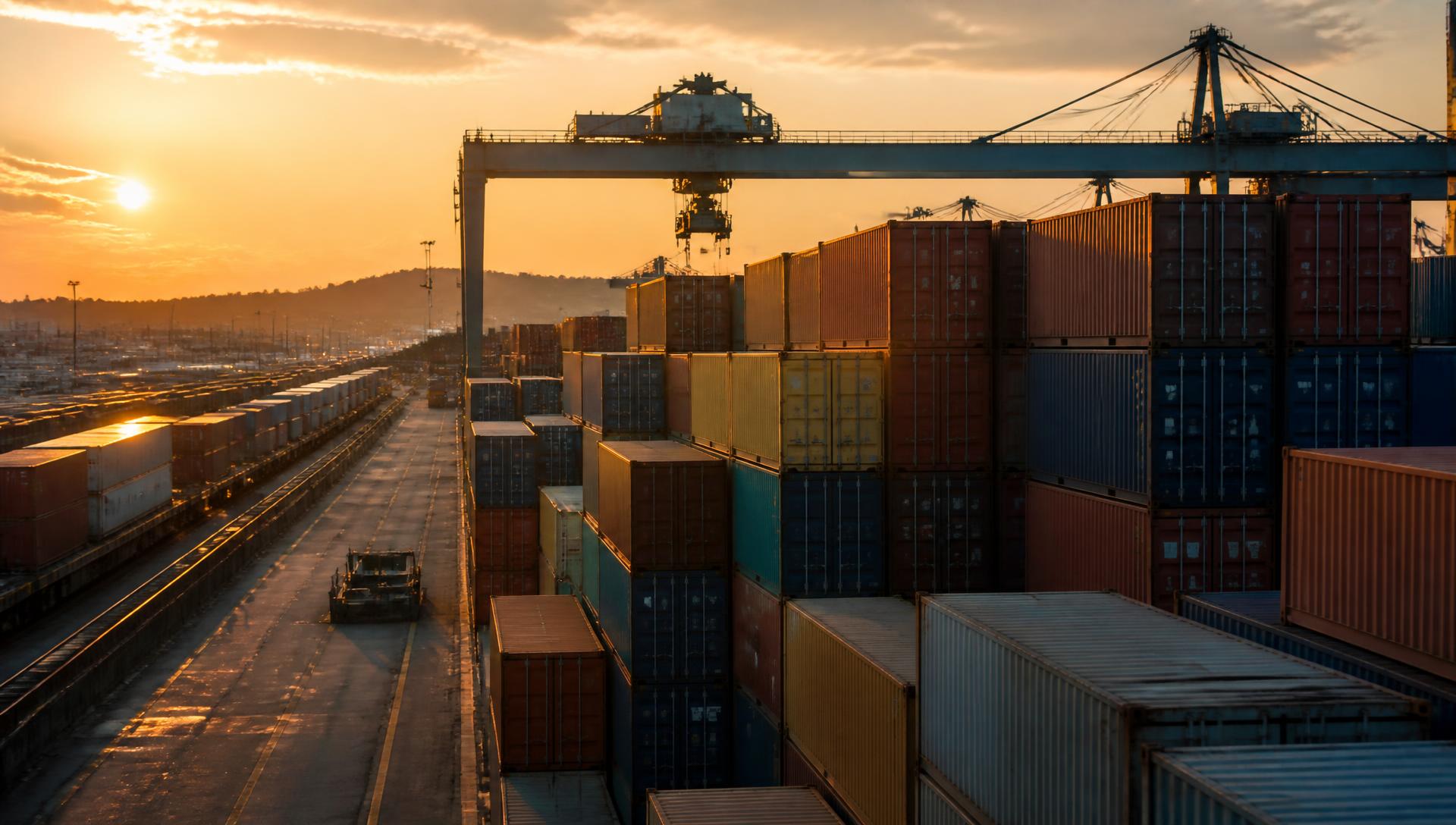
For years, lean inventories and just-in-time supply chains were considered signs of operational efficiency. The objective was straightforward: keep inventory moving, minimize storage costs, and avoid tying up unnecessary capital.
That model still has value.
But international trade is operating in a different environment today.
Changing tariff policies, geopolitical conflicts, disruptions along major shipping routes, fluctuating transportation costs, and increasingly unpredictable lead times are forcing importers to reconsider how much inventory is truly “too much.”
The question is no longer simply:
How little inventory can we carry?
Increasingly, businesses are asking:
How much inventory do we need to protect continuity when uncertainty becomes part of normal operations?
An Earlier Shipping Season Tells a Larger Story
Recent U.S. import data provides a revealing example.
U.S. seaports handled approximately 2.5 million twenty-foot equivalent units (TEUs) of containerized imports in July 2026, the fourth-highest July volume on record. Although volumes were lower than July 2025, importers accelerated shipments partly in anticipation of changing U.S. tariff measures.
Just days earlier, the National Retail Federation and Hackett Associates reported that this year’s seasonal import surge had already passed its peak. The busiest month appears to have occurred in May, much earlier than the traditional late-summer or fall peak shipping season.
This is more than a seasonal logistics anomaly.
It reflects a change in how companies are responding to risk.
Instead of waiting for uncertainty to resolve itself, many importers are moving goods earlier, building additional lead time into purchasing decisions, and positioning inventory before anticipated disruptions or cost increases occur.
The traditional shipping calendar is becoming less predictable because the risks influencing it are no longer confined to one part of the supply chain.
From Just-in-Time to Just-in-Case?
The shift does not mean companies should abandon lean inventory management.
Holding additional inventory carries real costs: warehousing, insurance, financing, handling, spoilage risk, and capital that cannot be deployed elsewhere in the business.
But running inventory too tightly also carries a cost—and that cost can be much harder to measure until something goes wrong.
A delayed vessel can interrupt supply.
A tariff change can alter landed cost while an order is being planned.
A disruption in the Red Sea, the Strait of Hormuz, or the Panama Canal can affect routes, transit times, fuel surcharges, or freight availability.
A production delay at origin can become a stockout thousands of miles away.
The World Trade Organization has identified frontloading and inventory accumulation as important responses to recent trade-policy uncertainty. In 2025, U.S. imports increased as companies brought purchases forward ahead of anticipated tariff increases, contributing to higher inventories in several sectors.
That behavior continues to influence how businesses think about supply-chain resilience in 2026.
The lesson is not that more inventory is always better.
The lesson is that the appropriate inventory level must increasingly account for the cost of uncertainty.
Inventory Is Becoming a Risk-Management Decision
There is an important distinction between excess inventory and strategic inventory.
Excess inventory exists because demand was misjudged, purchasing was poorly controlled, or products simply are not moving.
Strategic inventory exists because a company has deliberately decided that the cost of carrying additional product is lower than the potential cost of being unable to supply its customers.
That calculation will be different for every business.
An importer may decide to maintain several additional weeks of supply for a critical product. Another may place purchase orders earlier but maintain the same overall inventory level. Another may diversify suppliers or origins rather than increase inventory significantly.
These are different strategies, but they address the same underlying issue:
Resilience requires options.
Inventory is one of those options.
For Food Importers, the Calculation Is More Complex
For companies importing food products—particularly frozen products—the decision becomes even more nuanced.
Additional inventory cannot simply be placed in an ordinary warehouse.
Frozen products require temperature-controlled storage. Cold-storage capacity has a cost. Products have shelf lives. Inventory rotation matters. Packaging and production schedules must be coordinated. Reefer equipment availability and refrigerated transportation can introduce additional constraints.
That means the answer is not necessarily to fill a freezer with as much product as possible.
It is to understand the entire supply chain well enough to determine where additional protection creates value.
For example, the most effective buffer may not be finished inventory in the United States.
It could be:
- securing production capacity earlier at origin;
- placing purchase orders further in advance;
- maintaining additional raw-material or packaging availability;
- building more flexibility into shipping windows;
- using more than one qualified supplier or production source;
- or maintaining additional finished inventory for products that are difficult to replace quickly.
The right strategy depends on the product, the market, the supplier relationship, and the consequences of a disruption.
Earlier Ordering Does Not Eliminate Risk
There is another important consideration.
Frontloading inventory can protect a company from one risk while exposing it to another.
Importing earlier may reduce exposure to an anticipated tariff increase or shipping disruption—but it may also create excess inventory if demand weakens.
Holding more product can protect customer service levels—but it increases working-capital requirements.
Diversifying suppliers can reduce dependence on one source—but managing multiple suppliers can increase complexity and quality-control requirements.
There is no universal formula.
This is why resilience should not be confused with simply carrying more stock.
The objective is to create a supply chain capable of absorbing disruption without creating unnecessary financial strain.
The Cost of Waiting Has Changed
Perhaps the most important change in today’s trading environment is that waiting for certainty can itself become expensive.
A company waiting for a tariff decision may lose a production window.
A buyer waiting for freight rates to fall may encounter a new surcharge instead.
An importer delaying an order may discover that competitors have already reserved available production capacity.
None of this means businesses should react impulsively to every headline.
It means purchasing decisions increasingly require scenario planning.
What happens if transit takes two weeks longer?
What happens if freight costs rise?
What happens if a supplier misses a production window?
What happens if a tariff changes before the next shipment?
And perhaps most importantly:
How long can the business continue serving its customers if the next shipment does not arrive when expected?
That question can reveal more about an appropriate inventory strategy than a traditional inventory target alone.
Efficiency Is Being Redefined
The most efficient supply chain is not necessarily the one carrying the least inventory.
It is the one that balances capital, availability, flexibility, and risk in a way that supports the business.
Recent import patterns suggest companies are already adjusting to this reality. Peak shipping periods are moving earlier, importers are responding faster to potential disruptions, and purchasing decisions are increasingly influenced by events that may occur months after an order is placed.
The World Trade Organization’s 2026 outlook also illustrates the broader environment. Global merchandise trade remains resilient, but trade-policy activity, geopolitical conflict, energy costs, and transportation disruptions continue to influence the outlook for 2026.
For importers, resilience does not require predicting every disruption.
It requires building a supply chain that can continue functioning when predictions are wrong.
And increasingly, that may mean viewing inventory not simply as a cost on the balance sheet—but as one component of a broader risk-management strategy.
Conclusion
International trade will always involve uncertainty. What has changed is the frequency with which businesses are being asked to respond to multiple uncertainties at the same time.
Tariffs can change. Shipping routes can be disrupted. Freight costs can move quickly. Production schedules can tighten. Customer demand does not necessarily wait for any of them.
The companies best positioned for this environment will not necessarily be those carrying the most inventory—or the least.
They will be the companies that understand their supply chains deeply enough to know where flexibility is worth paying for.
That may mean additional inventory.
It may mean earlier purchasing.
It may mean diversified sourcing.
And often, it will mean some combination of all three.
Continue Reading
The Modern Supply Chain: From Efficiency to Resilience
References
Reuters — “July U.S. container imports hit fourth-highest on record, Descartes says” — August 10, 2026 Supports the July 2026 U.S. container-import figures, frontloading behavior, tariff uncertainty, and continuing shipping-route pressures.
Reuters — “Early surge in U.S. container imports coming to an end, shippers say” — August 7, 2026 Supports the discussion of the unusually early 2026 peak shipping season and importers preparing earlier for supply-chain shocks.
World Trade Organization — Global Trade Outlook and Statistics 2026 Provides the WTO’s 2026 global trade outlook and supporting analysis of merchandise and services trade.
World Trade Organization — “Middle East conflict weighs further on slowing trade outlook” — March 19, 2026 Supports the discussion of frontloaded imports, trade-policy uncertainty, energy costs, transportation disruption, and supply-chain resilience.
World Trade Organization — “Goods trade holding up despite Middle East conflict and high energy prices” — June 5, 2026 Provides more recent evidence on merchandise trade, container shipping, transport conditions, and continuing geopolitical pressures.