
One Fruit, Different Traditions: Açaí in the Amazon and Around the World
In Pará, açaí can be part of lunch. In other markets, it might be breakfast, a snack or dessert. What changes when a familiar food travels?
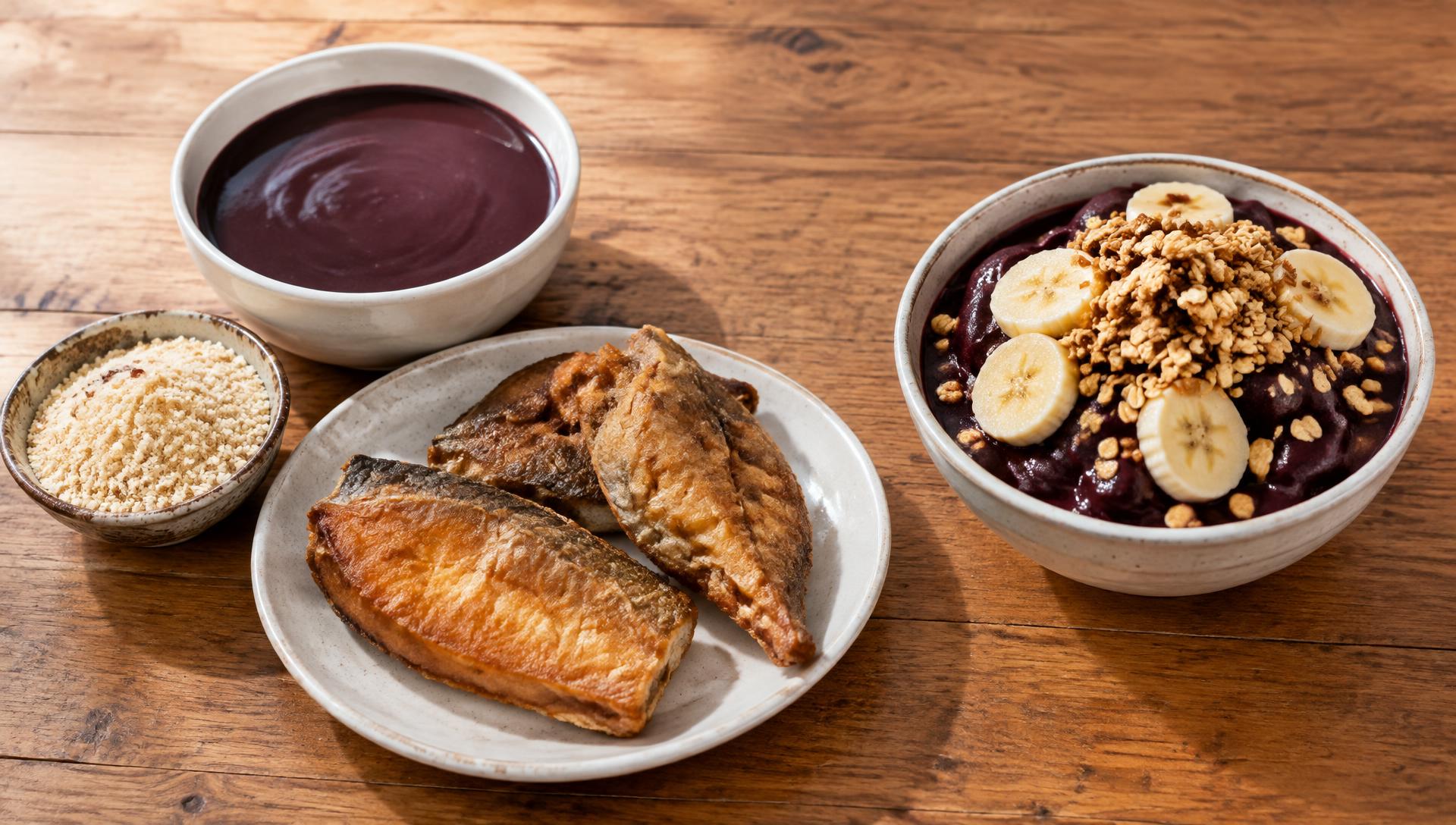
In Belém, a bowl of açaí can arrive alongside fried fish and cassava flour. In a café far from the Amazon, it might come frozen, topped with banana and granola.
Both are bowls of açaí. But if you ordered one expecting the other, you might wonder whether you had asked for the right thing.
That difference tells us something about how food travels. The fruit can keep its name and its deep purple color while taking on a different role in the meal.
In Pará, Açaí Can Be Lunch
In parts of the Brazilian Amazon, açaí is an everyday food. In Pará, one familiar way to eat it is to stir cassava flour into the pulp and serve it alongside fish, shrimp or meat. The pulp may be unsweetened, and the fish is often served separately. You can take a spoonful of açaí and then a bite of fish. The combination makes sense when you think of the açaí as part of the meal. Research on açaí preparations in Belém
There’s also a neighborhood business behind that bowl. Embrapa describes the batedores de açaí, small local operators who pulp the fruit and sell it to customers. Their work connects the harvest to people buying açaí for meals in towns and cities. Embrapa: Açaí uses, processing and products
That everyday pattern can be hard to picture if you first met açaí on a smoothie menu. But it’s also easy to overstate the contrast. Embrapa documents sweet preparations in producing regions, too, including pulp served with sugar and sometimes tapioca flour. The Amazon has more than one way of eating açaí.
The Fruit Changed Roles Within Brazil, Too
The contrast between the lunch bowl and the sweet bowl doesn’t begin at Brazil’s border. The familiar açaí na tigela—açaí served in a bowl—also has a place in Brazilian food culture. In a sweet preparation, the pulp can be blended with banana or guaraná syrup and served cold, with fruit or granola on top.
What changes is the part açaí plays. At a meal in Pará, it can sit alongside savory food. In a sweet bowl, the açaí blend becomes the base, and everything else is chosen to go with it. The texture matters differently, too: pulp you can pour and stir into flour serves one purpose; a thick frozen blend that holds toppings serves another.
The same name can cover both. That’s part of what makes açaí so adaptable—and why it’s worth asking what someone means when they say they’re having a bowl.
What Travels Across Borders
People don’t have to adopt a food in the same way it’s eaten where it grows. A frozen açaí bowl fits a café menu alongside smoothies and breakfast dishes. A manufacturer might use the fruit in a frozen dessert. Someone making breakfast at home might buy a packet of pulp and blend it with ingredients they already have.
A study of açaí’s cross-border trade, based on fieldwork in a riverine community in Amapá, follows both sides of that journey. It examines how local producers participate in an export supply chain and how the fruit is presented to international consumers. The açaí bowl is one example of a food acquiring a new identity abroad while retaining a connection to its Amazonian origins. Food and Commodity: The Cross-Border Life of Açaí
That connection is easy to flatten. A menu can say “Amazonian açaí” and tell us something about the fruit’s roots, while the recipe itself tells us more about the place serving it. Both are useful pieces of the story.
The Same Name Can Describe Different Products
For a buyer, the difference shows up before anything reaches the bowl. A package of unsweetened pulp gives a kitchen room to decide how to use it. A prepared bowl base may already contain other ingredients that affect its sweetness and texture. The two can both be sold as açaí, but substituting one for the other can change the finished recipe.
A café that wants a consistent frozen bowl and a chef who wants to serve açaí with fish could be looking for different products. The practical question is simple: What should this açaí do when it reaches the kitchen? Once that’s clear, the ingredient list and product specification are much easier to interpret.
Editor’s Perspective
If you first encountered açaí under a layer of banana and granola, it’s worth picturing it next to a plate of fish. The second bowl tells you something the first one can’t: what this fruit means in a place where it has long been part of everyday meals.
International trade gives foods new uses and new audiences. Learning how people eat a food where it comes from adds something to the experience, even if you still order yours with granola.
Key Takeaways
- In parts of Pará, açaí pulp is an everyday food served with cassava flour and savory accompaniments such as fish or shrimp.
- Sweet preparations also exist in the Amazon and elsewhere in Brazil. The difference can’t be reduced to Brazil versus the rest of the world.
- International bowls and smoothies give açaí a different role in the meal. For buyers, that can mean choosing between unsweetened pulp and a blend designed for a specific use.
Continue Reading
- How Açaí Became a Global Superfruit
- Sustainability Is Becoming a Business Requirement, Not a Marketing Strategy
- Brazilian Tropical Fruit Pulps: A Buyer’s Guide to Products, Processing and International Trade
Sources & Further Reading
- Embrapa — Açaí uses, processing and products — https://www.infoteca.cnptia.embrapa.br/infoteca/bitstream/doc/1096244/1/livrointernacionalAcai03aset2018.pdf
- Revista da Associação Brasileira de Nutrição — Study of açaí preparations consumed in Belém — https://rasbran.com.br/rasbran/article/view/1032
- Brazil’s Ministry of Integration and Regional Development — Rota do Açaí — https://www.gov.br/mdr/pt-br/assuntos/desenvolvimento-regional/rotas-de-integracao-nacional/rota-do-acai-1
- Food and Commodity: The Cross-Border Life of Açaí — https://www.sciencedirect.com/science/article/pii/S3050502X26000082