
One Crop, Two Markets: How Sugar and Ethanol Connect Food and Energy
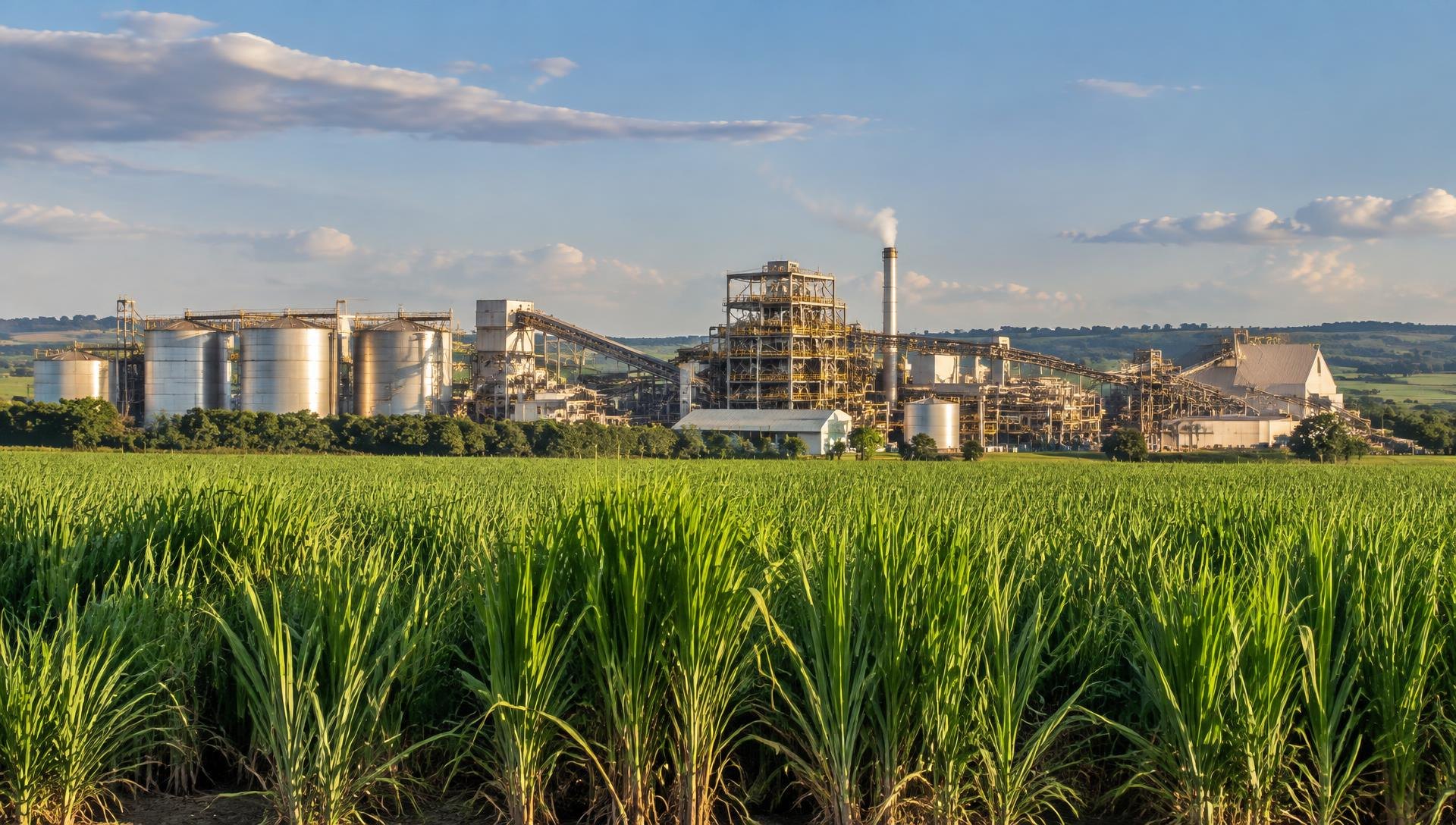
Why understanding the sugar market sometimes means looking beyond food.
What does the price of fuel have to do with the sugar in a bakery, a beverage or a supermarket shelf?
At first, the connection may seem distant. Sugar belongs in the food business. Ethanol belongs in the energy business.
But in Brazil, those two markets meet in the same field.
Sugarcane provides the raw material for both. After harvest, decisions made at the mill help determine how much of that agricultural production becomes sugar and how much becomes fuel.
For international buyers, this creates an important connection: understanding sugar supply requires looking at what else the crop can produce.
The Choice Behind the Harvest
A field of sugarcane does not represent a fixed quantity of finished sugar.
The cane must be harvested and processed. Its usable sugar content matters, as do the mill’s equipment and operating capabilities.
At facilities equipped to produce both sugar and ethanol, part of the available raw material can be directed toward either product. The balance between those destinations is commonly called the production mix.
That flexibility gives the producer a commercial choice.
If sugar offers the more attractive return, there may be an incentive to allocate more production toward sugar. If ethanol offers a better return, the incentive can shift.
An IMF analysis of Brazil’s ethanol industry describes how mills’ ability to adjust production connects their decisions to relative prices in the two markets. Source
The same crop serves two different sources of demand.
Why the Fuel Market Matters
Ethanol has an established role in Brazilian transportation, both as a component of gasoline and as a fuel sold separately for compatible vehicles.
That means sugarcane processors are connected to demand from motorists as well as food manufacturers.
When evaluating production, a mill must consider the returns available from its different products. A sugar quotation becomes part of a wider calculation involving ethanol prices, processing costs and the commercial conditions facing that particular operation.
This connection appears clearly in USDA’s April 2026 Brazil Sugar Annual. The report anticipated a shift toward ethanol in the 2026/27 production mix, citing domestic ethanol demand and its relative profitability. That was a forecast at the time of publication, rather than a final result for the season. Source
The useful lesson extends beyond any single forecast.
A change in the energy market can influence the commercial attractiveness of producing sugar—even when demand from food buyers has not changed.
A Bigger Harvest Does Not Tell the Whole Story
Imagine a season in which more cane is harvested, but a smaller share is directed toward sugar.
Would sugar production necessarily increase?
The answer depends on the size of the harvest, the recoverable sugar in the cane and the production mix.
A larger crop could compensate for a lower allocation to sugar. Alternatively, the shift toward ethanol could absorb enough of the increase that sugar output changes very little—or declines.
This is why headlines about agricultural production need context.
“More cane” and “more sugar” are related ideas, but they are not interchangeable.
For someone purchasing sugar internationally, the distinction helps explain why an encouraging harvest estimate does not, by itself, establish that more export supply will become available.
The practical question is: how much of that crop is likely to become the product the buyer needs?
Flexibility Has Limits
The production mix should not be imagined as a switch that every mill can move freely from one extreme to another.
Facilities differ. Equipment, processing capacity and operating plans influence what each can produce.
Commercial commitments also matter. A producer with contracted deliveries faces a different decision from one assessing uncommitted output.
An economic incentive therefore does not automatically translate into an immediate production change.
There is also feedback between the markets. If more production moves toward ethanol, the additional ethanol supply can affect its price and change the original incentive.
CEPEA’s January 2026 analysis highlighted this interaction: weaker sugar prices could encourage a greater allocation toward ethanol, while additional ethanol production could put pressure on the biofuel’s own prices. Source
The relationship keeps evolving as producers respond to conditions.
One Connection Among Several
Does this mean higher oil prices automatically produce higher sugar prices?
No. That would turn a useful connection into an unreliable rule.
Fuel prices can influence the environment in which ethanol competes, but the relationship between energy and sugar also passes through domestic fuel pricing, demand and producers’ operating decisions.
The International Energy Agency’s analysis of Brazilian biofuels describes the importance of harvest seasonality and the wider economics of ethanol production. Source
For buyers, energy is another part of the picture to understand. It does not replace the need to assess sugar production, consumption, inventories and availability.
It helps explain why the market can move for reasons that begin outside the food industry.
Looking Beyond the Product
A bakery purchases sugar because it needs an ingredient. A beverage manufacturer buys it to support a formulation. An importer evaluates it as part of a supply program.
None of them needs to become an energy trader.
But understanding the connection between sugar and ethanol makes the market less mysterious. It encourages better questions about harvest expectations, production decisions and the assumptions behind an offer.
Sugarcane illustrates how closely different industries can be connected.
Before sugar reaches the food market, its raw material is already part of a decision involving both food and energy.
That is what makes this crop—and the trade built around it—more interesting than its familiar appearance might suggest.
Key Takeaways
- Brazilian sugarcane supplies both sugar and ethanol markets.
- Relative returns can influence how mills allocate production, within their capabilities and commitments.
- A larger cane harvest does not automatically mean a proportional increase in sugar output.
- Energy-market developments help explain sugar-market conditions, but they do not provide a simple price-prediction rule.
Continue Reading
Brazil and the Global Sugar Supply
The Hidden Complexity of Global Sugar Trade: Why Price Is Only Part of the Equation
Sources & Further Reading
USDA Foreign Agricultural Service — Brazil Sugar Annual, April 2026 https://apps.fas.usda.gov/newgainapi/api/Report/DownloadReportByFileName?fileName=Sugar+Annual_Brasilia_Brazil_BR2026-0020.pdf
International Monetary Fund — Regional Economic Outlook, Chapter 3, including Brazil’s sugarcane-based ethanol program https://www.imf.org/-/media/files/publications/reo/whd/2021/english/ch3.pdf
CEPEA/ESALQ-USP — Ethanol market analysis, January 2026 https://www.cepea.org.br/upload/revista/pdf/0243197001770396920.pdf
International Energy Agency — How competitive is biofuel production in Brazil and the United States? https://www.iea.org/articles/how-competitive-is-biofuel-production-in-brazil-and-the-united-states