
The Return of the Suez Canal: How Changing Shipping Routes Could Reshape Global Trade
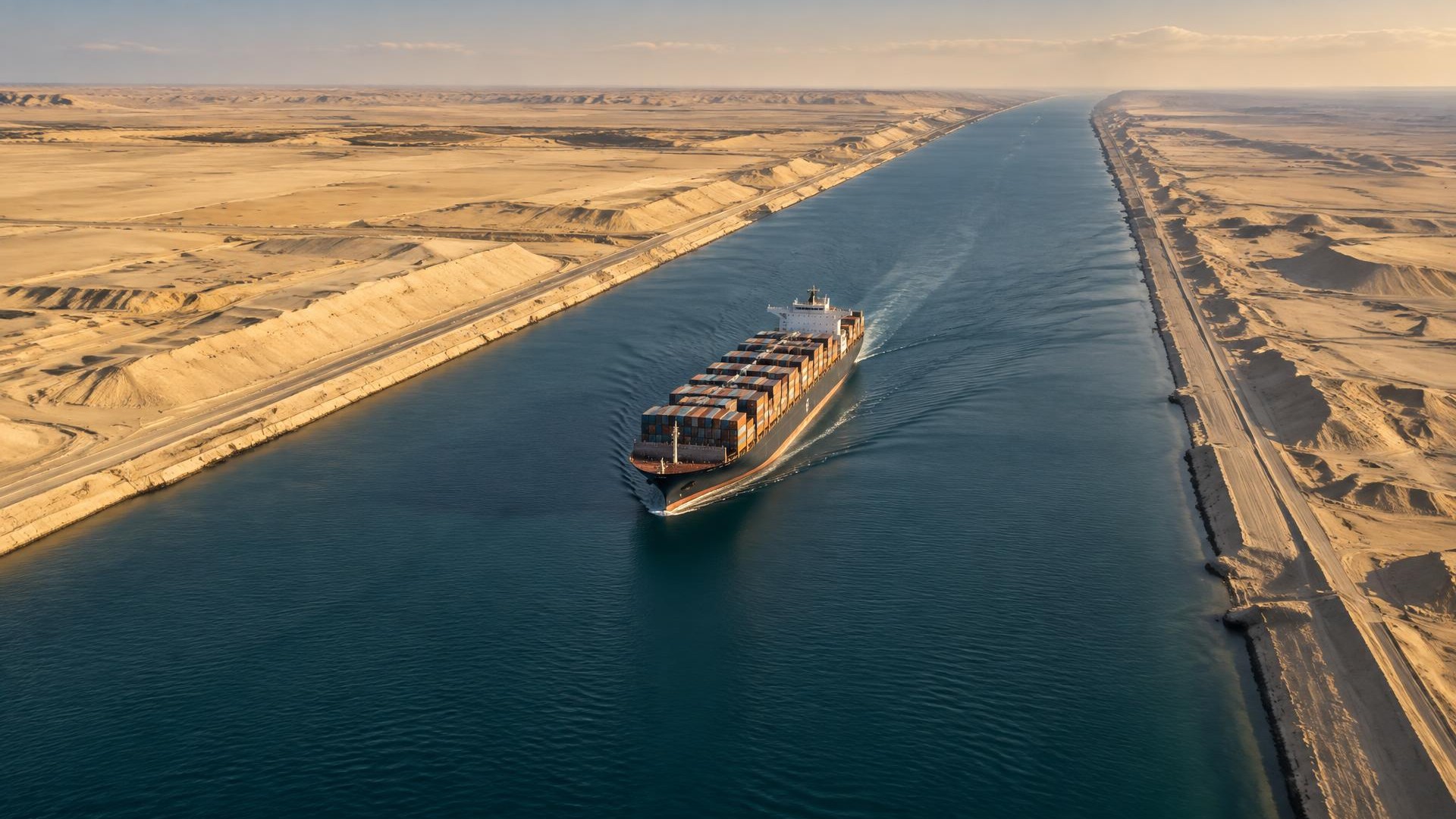
After years of disruption, container shipping is gradually returning to one of the world’s most important maritime corridors. But shorter routes do not automatically mean cheaper freight, and the implications for global supply chains may be more complex than expected.
A vital trade corridor begins to recover
For decades, the Suez Canal has served as one of the most important connections in international commerce, allowing vessels to travel between Asia and Europe without navigating around the southern tip of Africa.
When security threats in the Red Sea intensified in late 2023, major shipping companies began diverting vessels around the Cape of Good Hope. The resulting disruptions extended transit times, increased operating costs, and changed the way global shipping capacity was deployed.
Nearly three years later, the industry is beginning to see a meaningful shift.
According to Lloyd’s List Intelligence, 1,228 vessels transited the Suez Canal in September 2026. That represented a 21% increase compared with September 2025, although traffic remained approximately 39% below pre-crisis levels.
More recently, shipping association BIMCO reported that weekly container ship capacity transiting the canal averaged approximately 753,000 twenty-foot equivalent units (TEUs) during the first two weeks of October 2026, compared with approximately 1.46 million TEUs during the corresponding period in 2023.
These figures suggest that the recovery is gaining momentum, but they also illustrate how far the shipping industry remains from a complete return to its previous operating patterns.
The question is no longer simply whether vessels will return to the Suez Canal. It is how that transition could influence international freight markets, supply-chain planning, and commercial decisions.
Why the Suez Canal matters so much
Geography plays a fundamental role in international trade.
The Suez Canal connects the Mediterranean Sea with the Red Sea, creating a direct maritime passage between European and Asian markets. Without this connection, vessels serving many Asia–Europe routes must travel around Africa.
The difference can be substantial.
In its Review of Maritime Transport 2024, UN Trade and Development (UNCTAD) illustrated the impact using a voyage between Shenzhen, China, and Rotterdam, Netherlands.
Illustrative Shenzhen–Rotterdam voyage
Via Suez Canal: approximately 31 days and 10,000 nautical miles. Via Cape of Good Hope: approximately 41 days and 13,000 nautical miles. Additional voyage time: approximately 10 days. Actual distances and times vary by service, vessel speed, ports, and operating conditions. Source: UNCTAD, Review of Maritime Transport 2024.
Longer routes require more fuel and vessel operating time. They can also affect crew scheduling, equipment availability, inventory planning, and the number of ships needed to maintain regular services.
For companies purchasing goods internationally, those additional days may influence working capital, warehouse requirements, delivery commitments, and ultimately the competitiveness of imported products.
What is changing in October 2026?
Recent shipping data indicates that major container carriers are gradually restoring services through the Red Sea and Suez Canal.
According to Alphaliner data reported on October 21, approximately 63% of deployed container capacity on Far East–Europe services was operating on routes using the Red Sea during the September 15–October 15 period. This is a measure of deployed capacity on that specific trade, rather than a claim that 63% of all global shipping has returned.
Other indicators point in the same direction.
Ocean freight analytics firm Xeneta reported that scheduled weekly container capacity crossing the Bab el-Mandeb Strait had doubled over six weeks, reaching approximately 448,000 TEUs in early October. Nevertheless, the figure remained well below its August 2023 level.
Major carriers are also adjusting their service networks. Maersk and Hapag-Lloyd have announced the restoration of additional services through the Suez route, although implementation remains phased and subject to changing conditions.
On October 22, Reuters reported that Kuehne+Nagel CEO Stefan Paul expects most container shipping lines to resume using the Suez route by late first quarter or early second quarter of 2027. Importantly, that remains an industry expectation, not a confirmed timetable.
Together, these developments point toward a significant transition in global maritime logistics.
However, the pace and permanence of that transition will depend heavily on security conditions.
Could shorter shipping routes lead to lower freight rates?
At first glance, the economics appear straightforward.
Shorter voyages generally require less fuel, fewer sailing days, and potentially lower operating costs.
But ocean freight pricing is influenced by more than the distance between two ports.
It also reflects the balance between shipping capacity and cargo demand, equipment availability, port conditions, carrier scheduling, fuel costs, and commercial competition.
The return to shorter routes could introduce an important change to that balance.
During the Red Sea disruptions, longer voyages effectively absorbed additional shipping capacity. Vessels spent more time completing each journey, which meant carriers needed more ships to maintain comparable service frequencies.
As routes become shorter again, some of that capacity may be released back into the global shipping network.
BIMCO has estimated that rerouting around Africa increased container ship demand by approximately 10%. A sustained return through Suez could reverse part of that effect and place downward pressure on freight rates, depending on market conditions.
Yet lower operating costs do not guarantee immediate or proportionate reductions in the rates paid by importers.
Shipping lines may adjust vessel deployment, sailing frequency, capacity, and pricing strategies. Market demand may also change independently of routing decisions.
For importers and exporters, the key distinction is between a potential reduction in transportation costs and an actual reduction in quoted freight rates.
Those two developments do not necessarily occur at the same time.
A transition that could create new logistical challenges
Returning to the Suez Canal may improve long-term transportation efficiency, but the transition itself could create temporary operational uncertainty.
Shipping networks are carefully coordinated systems involving vessels, port terminals, inland transportation, container equipment, and delivery schedules.
Changing a major international route requires carriers to reorganize parts of those networks.
Potential challenges include revised vessel arrival schedules, changes to port rotations, temporary imbalances in container availability, and adjustments to service frequency.
For businesses operating with limited inventory or strict delivery commitments, even relatively small schedule changes can have commercial consequences.
This is especially relevant for food and agricultural products.
Some commodities are highly sensitive to delivery timing, temperature management, seasonal availability, or customer production schedules.
A shorter ocean voyage may be beneficial, but predictable transportation and proper cargo handling remain equally important.
The practical lesson is that improved route efficiency should not be confused with an immediate return to fully predictable supply chains.
What this means for importers, exporters, and international buyers
As shipping networks evolve, businesses involved in international sourcing should pay attention to several factors.
Freight quotations and validity periods. Freight rates may respond to changing capacity and market conditions. Buyers should understand how long a quotation remains valid and which surcharges are included.
Transit times and routing commitments. An estimated transit time is not a guarantee. Companies should confirm whether quotations reflect a Suez routing or a Cape of Good Hope diversion, especially where delivery timing is critical.
Inventory and purchasing decisions. More efficient transportation could eventually reduce the need for some inventory buffers. However, adjusting purchasing strategies too early may expose businesses to renewed disruption.
Total landed costs. Freight is only one component of the final cost of an imported product. Insurance, duties, terminal charges, inland transportation, and other destination expenses must also be considered.
Commercial flexibility. Importers and exporters may benefit from reviewing delivery terms, shipment schedules, and alternative routing options with their logistics partners.
These considerations apply across many industries, from manufactured products and consumer goods to agricultural commodities and food ingredients.
For companies sourcing internationally, the most effective approach is not necessarily to predict the next freight-rate movement, but to remain informed and maintain flexibility as conditions evolve.
The sustainability dimension: fewer miles, but not the whole picture
The return to shorter maritime routes also has potential environmental implications.
Longer voyages generally require additional fuel consumption and can generate greater greenhouse gas emissions, depending on vessel speed, fuel type, and operating conditions.
UNCTAD’s Review of Maritime Transport 2025 identified increased shipping emissions associated with longer rerouted voyages during 2024.
A return to more direct routes could therefore contribute to improved transportation efficiency and lower emissions for certain voyages.
However, overall environmental performance also depends on fleet technology, fuel choices, vessel utilization, and operational practices.
Reducing sailing distance is one important element of maritime sustainability, but it is not a substitute for broader improvements across the shipping industry.
Looking ahead: a more efficient but still uncertain 2027
The recovery of the Suez Canal is an encouraging development for international trade.
Increasing traffic, returning container services, and revised industry expectations all suggest that shipping companies are preparing for a different operating environment in 2027.
Nevertheless, the security situation in the Red Sea remains a critical uncertainty.
A renewed deterioration could prompt carriers to reverse routing decisions, while a sustained improvement could accelerate the return of services and reshape the balance between global vessel capacity and freight demand.
For businesses, the coming months may bring opportunities for shorter transit times and potentially more competitive freight conditions.
But those benefits should be evaluated carefully, rather than assumed.
The companies best positioned to navigate this transition will be those that understand both the opportunities and the risks associated with changing transportation networks.
Because in international trade, the shortest route is not always the most reliable one — and the lowest freight quotation is not always the most economical shipping decision.
Editor’s Perspective
The evolving situation in the Suez Canal demonstrates how closely global commerce depends on maritime infrastructure, regional stability, and operational flexibility.
A change in one major shipping corridor can influence transportation costs, vessel availability, delivery schedules, and purchasing decisions across multiple continents.
For international buyers and suppliers, understanding these connections is essential to making informed commercial decisions.
The potential return to more efficient shipping routes is welcome news, but careful planning and realistic expectations remain important.
Key Takeaways
- Suez Canal traffic is recovering, but overall activity remains below pre-disruption levels.
- Major shipping lines are gradually restoring services through the Red Sea.
- Shorter voyages could release shipping capacity and place downward pressure on freight rates.
- Route changes may temporarily disrupt schedules, equipment positioning, and logistics planning.
- Security conditions remain the most significant uncertainty.
- Importers and exporters should evaluate routing, transit reliability, and total landed costs rather than focusing on freight prices alone.
Sources & Further Reading
Lloyd’s List Intelligence — Red Sea Brief, October 15, 2026 https://www.lloydslistintelligence.com/resources/blog/red-sea-brief-15-october-2026
BIMCO analysis — Suez Canal Container Ship Transits Rebound https://www.maritimeprofessional.com/news/suez-canal-container-ship-transits-423618
Alphaliner — Far East–Europe Capacity Returning to Suez https://shipandbunker.com/news/emea/932812-container-lines-shift-63-of-far-east-europe-capacity-back-to-suez-canal-alphaliner
Xeneta — Red Sea Container Capacity Doubles https://shipandbunker.com/news/world/915061-red-sea-container-shipping-return-gains-pace-as-capacity-doubles-xeneta
Reuters — Kuehne+Nagel Outlook for Suez Canal Return, October 22, 2026 https://www.reuters.com/world/middle-east/kuehnenagel-ceo-expects-most-container-lines-back-suez-canal-by-early-q2-2026-10-22/
UNCTAD — Review of Maritime Transport 2025 https://unctad.org/publication/review-maritime-transport-2025
Additional contextual reference: UNCTAD, Review of Maritime Transport 2024 (illustrative route comparison).